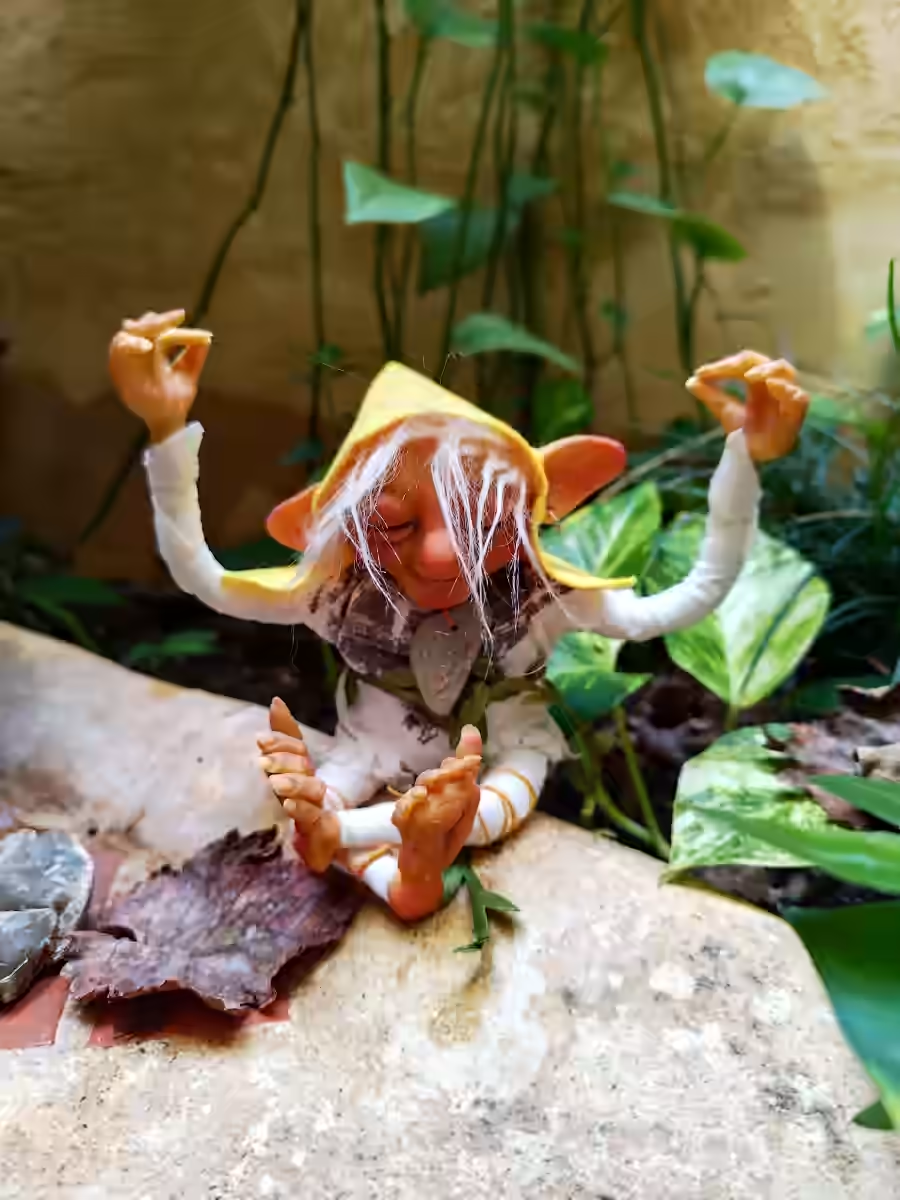
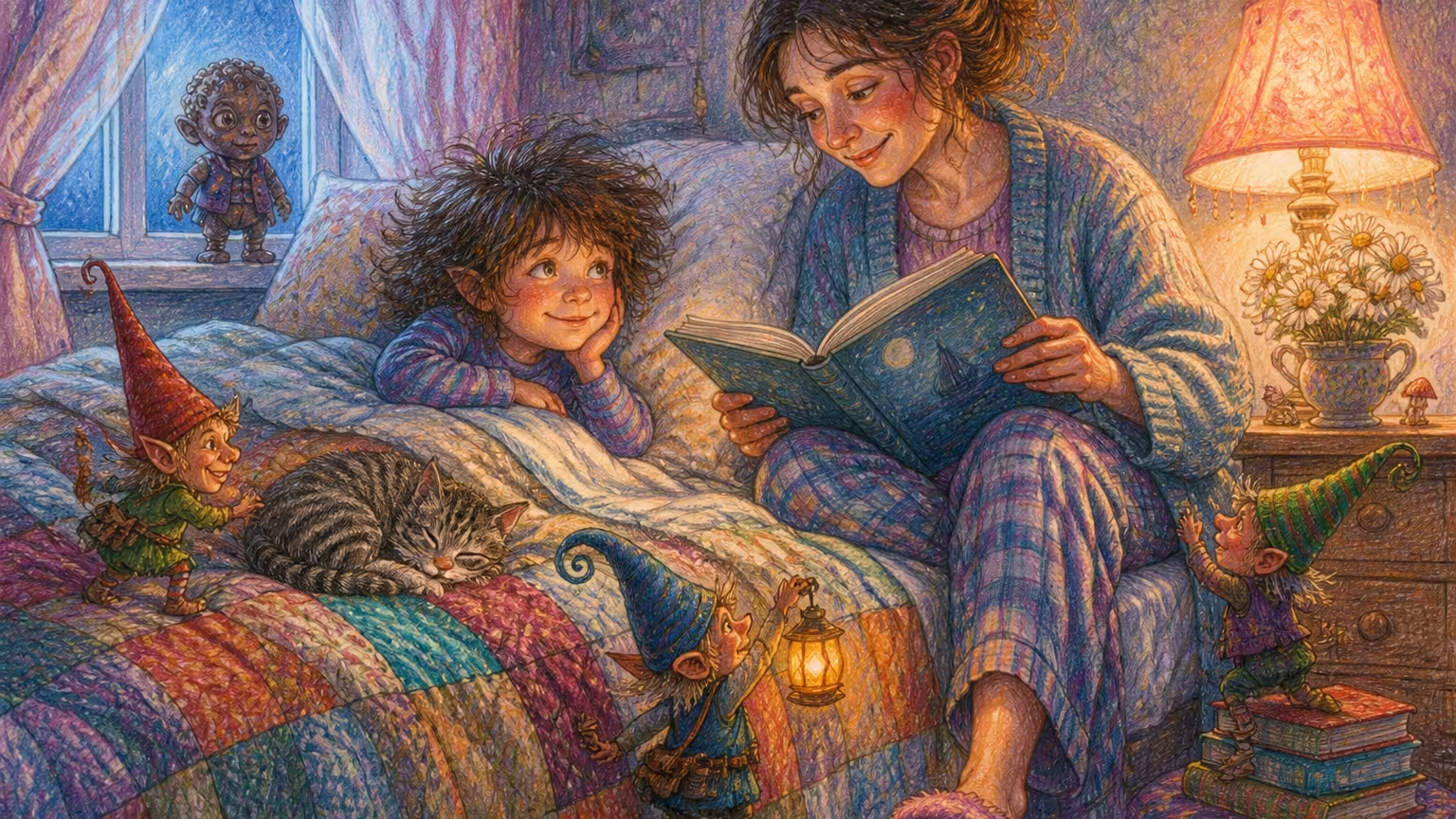
There is a moment, somewhere between 7:30 and 8:15 in the evening of most British family homes, when the lights go down in a child’s bedroom, a parent settles on the edge of the bed, and the world contracts to the size of a small lamp, an open book and a sleepy face on a pillow. This moment is one of the most resilient cultural practices in the English-speaking world: it has survived smartphones, streaming services, the disappearance of bedtime as a fixed concept in many other parts of life, and the rise of audiobooks. The bedtime story, in 2026, is still alive in millions of British, Irish, American, Canadian, Australian and New Zealand homes, every single night.
And among the bedtime stories that work best, there is a particular category that we Magikitos have a soft spot for: the magical bedtime story with handcrafted characters. A story about a brownie or a fairy or a pixie or a small woodland creature, told slowly, in a quiet voice, with a small handmade figure sitting on the shelf or on the windowsill while the story unfolds. The combination of the story and the physical character creates a particular kind of pre-sleep magic that no screen can replicate.
Today we will tell you what makes these stories work, where to find good ones, how to choose the characters that accompany them, and why this small evening practice is one of the most precious gifts you can give a child. If you want to explore the broader fairy ecosystem we draw on, our fairies collection is the natural starting point.
What makes a magical bedtime story work?
Four ingredients that combine to produce the right kind of pre-sleep effect. First ingredient: slow pacing. A bedtime story is not an action film, and the child does not need plot twists every two pages. Slow descriptive passages, repeated phrases, and pauses for breath are not weaknesses, they are features. A bedtime story that hurries the child along is doing the opposite of its job. Second ingredient: familiar characters. Children settle better with stories that include creatures they already know (a brownie, a fairy, a small woodland animal) than with characters they have to learn from scratch. The brain at bedtime is not in absorbing mode, it is in resting mode, and familiar characters provide the cognitive scaffolding for relaxation. Third ingredient: low-stakes plot. A bedtime story should not involve genuine danger, real loss, or unresolved conflict. Small mischief, gentle mysteries, lost objects that get found again, these are the right plot registers. Fourth ingredient: a sleep-conducive ending. The best bedtime stories end with the creature settling down to sleep itself, or with the resolution of a small worry, or with a gentle return to a familiar place. This emotional landing prepares the child for the actual landing into sleep.
If you analyse the bedtime story classics that have endured (Beatrix Potter, A. A. Milne, Cicely Mary Barker, the Magikitos older tales), you will find these four ingredients in every single one. They are not arbitrary: they reflect the cognitive needs of a tired child being prepared for sleep, and they have been refined by a hundred years of trial and error in British and American children’s literature.
Which classic British creatures work best in bedtime stories?
Five creature categories that have proven particularly effective in the British children’s literature tradition. First category: the brownie, the helpful household spirit who tidies things at night while the child sleeps. The brownie is almost the perfect bedtime character because its very function (working at night, being unseen, being kind) maps directly onto the rhythm of a child going to sleep. Second category: the small fairy, particularly the British rather than Disney variety, with her woodland habitat, her gentle magic, and her aversion to human attention. Third category: the woodland animal protagonist (badger, hedgehog, hare, fox), often anthropomorphised, which has been the staple of British bedtime stories from Beatrix Potter onwards. Fourth category: the cottage mouse, with her domestic scale and her gentle adventures around the kitchen and pantry. Fifth category: the friendly seasonal creature (snowflake spirit, autumn leaf creature, spring blossom keeper), which works particularly well in cyclical storytelling tied to the calendar.
What unites these five categories is small scale and gentle nature. Big creatures (dragons, ogres, giants) are too dramatic for bedtime. Sinister creatures (witches, ghosts, monsters under the bed) are obviously counterproductive. The bedtime story belongs to the world of the cosy and the small, and the creatures who populate it must fit that scale and that emotional register.
How long should a bedtime story be?
Between five and twelve minutes for younger children (3-6 years), between ten and twenty minutes for older children (7-10 years), and up to thirty minutes for the rare older child (10-12 years) who still asks for a story. These durations are based on observation across British and American families: shorter and the child does not have time to settle, longer and the child either falls asleep before the ending or becomes restless and over-stimulated. The five-to-twelve minute sweet spot for younger children corresponds neatly to the cognitive attention span of a sleepy preschooler, which is also why most professionally produced picture books are designed to be read in this exact range.
For older children, the right approach is to use a chapter-book strategy: read one short chapter per night, of about ten to fifteen minutes, with a clear stopping point that leaves the next chapter slightly anticipated. This rhythm builds long-term engagement (the child looks forward to bedtime to find out what happens next) and trains patience and continuity. Serialised stories like our own Taramundi chapters, the Beatrix Potter omnibus, and the Cicely Mary Barker fairy books all work well in this chapter-book format.
How do handcrafted characters change the experience?
By anchoring the abstract story to a physical object that the child can see, touch and remember. When a bedtime story features a brownie called Tom, and there is also a small carved wooden Tom sitting on the shelf above the bed, the story is no longer just words: it becomes a triangular relationship between the words, the figure, and the child. The figure exists during the day (when the child can see it and touch it), the story exists during the night (when the parent reads it), and the child holds both threads of the relationship. This physical anchoring deepens the emotional weight of the story considerably, and it makes the character feel real in a way that pure-text storytelling cannot achieve.
Research in early childhood education confirms what every grandmother already knew: children retain stories better when those stories are tied to physical objects, and they develop stronger emotional attachments to characters they can see and hold. A small handcrafted figure is therefore not just decoration, it is an active piece of the bedtime story infrastructure. We Magikitos have built our entire workshop around this principle for centuries: every creature has its story, every story has its creature.
Where can you find good magical bedtime stories today?
Three main sources, each with its own strengths. First source: the classic British children’s literature canon, particularly Beatrix Potter (Peter Rabbit, Squirrel Nutkin, Jemima Puddle-Duck and the rest), A. A. Milne (Winnie the Pooh), Kenneth Grahame (The Wind in the Willows), and Cicely Mary Barker (Flower Fairies). These books, mostly written between 1900 and 1950, set the gold standard for cosy bedtime storytelling, and they have been continuously in print for over a century because they work. Second source: contemporary picture books from British and Irish publishers, particularly Walker Books, Bloomsbury Children’s, and Penguin Random House Children’s lines, which include excellent newer stories with magical creatures. Third source: our own Magikitos community audio stories on stories, a growing collection of short magical narratives recorded by real families and storytellers from around the world. The audio format is particularly useful when the parent is tired and just wants to lie next to the child while a quiet voice does the actual storytelling.
Whichever source you choose, the rule of variety applies: rotate between sources rather than reading the same book every night. Classic books once a week, contemporary picture books another night, audio stories on the nights when you are too tired to read aloud, and your own improvised stories the rest of the time. This variety keeps the bedtime ritual fresh without losing its core comforting structure.
Should bedtime stories be read or told from memory?
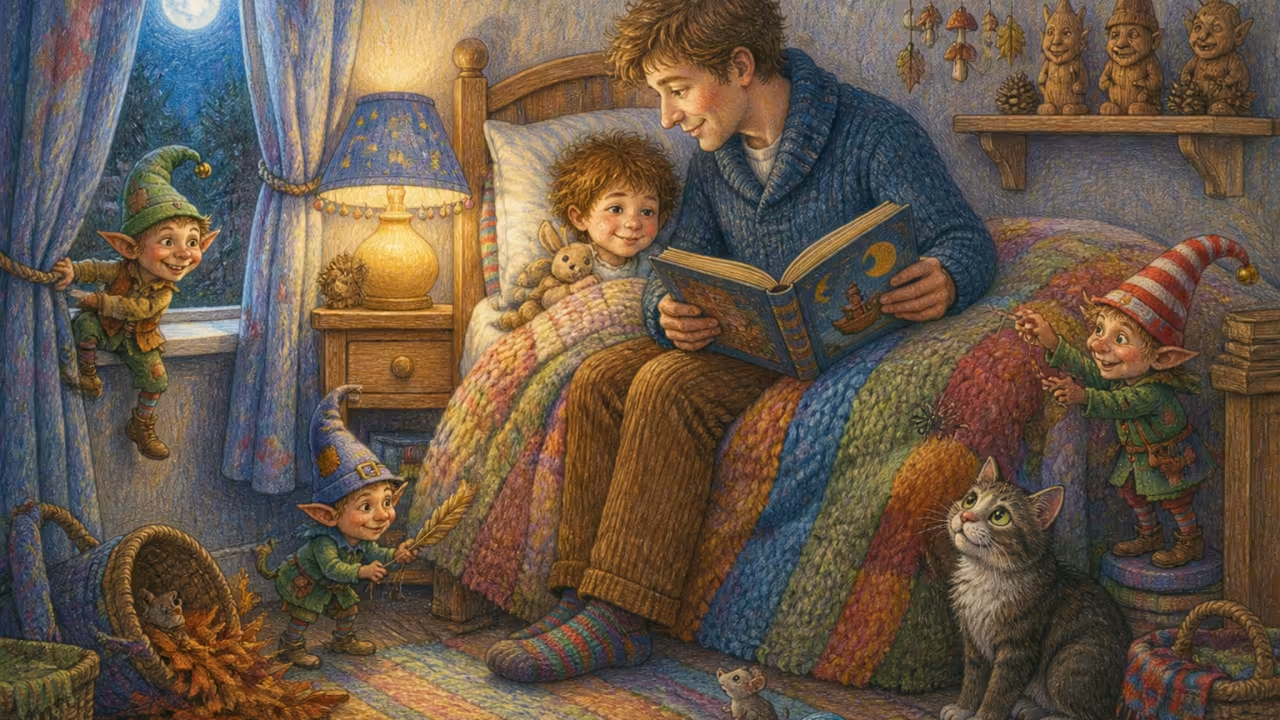
Both, in different proportions across childhood. Reading from a book has the advantage of consistency, beautiful illustrations, and the cultural inheritance of the printed page. It also allows the parent to recover narrative ground when tired, and to expose the child to the language of professional storytellers. Telling from memory has the advantage of personalisation (the child can be a character, family members can be incorporated, real-life situations can be gently mirrored), and of demonstrating to the child that storytelling is a human activity, not just a printed-book activity. The ideal balance, in our Magikitos experience, is roughly two-thirds reading and one-third improvising for younger children (3-6), shifting to half-half for older children (7-10).
The benefit of improvising occasionally is enormous and underestimated. When a child sees that their parent can simply make up a story, with a brownie called Tom and a fox called Vincent and a tiny tomato seed who learns to grow, they internalise a powerful lesson: stories are not things that come from outside, they are things humans make. This lesson scaffolds the child’s own future storytelling abilities, their imagination, their willingness to invent and create. A child who has watched a parent improvise stories at bedtime is more likely to grow up being able to improvise stories themselves, in any context, including the small social storytelling that helps adults survive office life, parties, and difficult conversations.
When is a child too old for bedtime stories?
Almost never, if the format adapts. The classic five-minute story with picture book is right for ages 3 to 6. Chapter-book reading is right for ages 7 to 11. Audio stories or longer narrative podcasts work well from age 8 onwards, especially during difficult transitional periods (changing schools, family changes, holidays). Even older children (12-15) often appreciate a quiet voice reading something before sleep, particularly when they are anxious about exams or social pressures. Some parents continue reading bedtime stories well into their child’s adolescence, simply because the ritual itself (the parent in the room, the voice in the dark, the slow descent into sleep) is valuable independently of the child’s reading ability.
The age at which children stop wanting bedtime stories varies enormously, and it is usually a sign of independence rather than disinterest. When your child starts saying I will read by myself tonight, accept it gracefully and stay in the room for ten minutes anyway, doing your own quiet reading. The bedtime ritual transitions from active storytelling to shared quiet presence, and that transition is just as valuable as the earlier story-based phase.
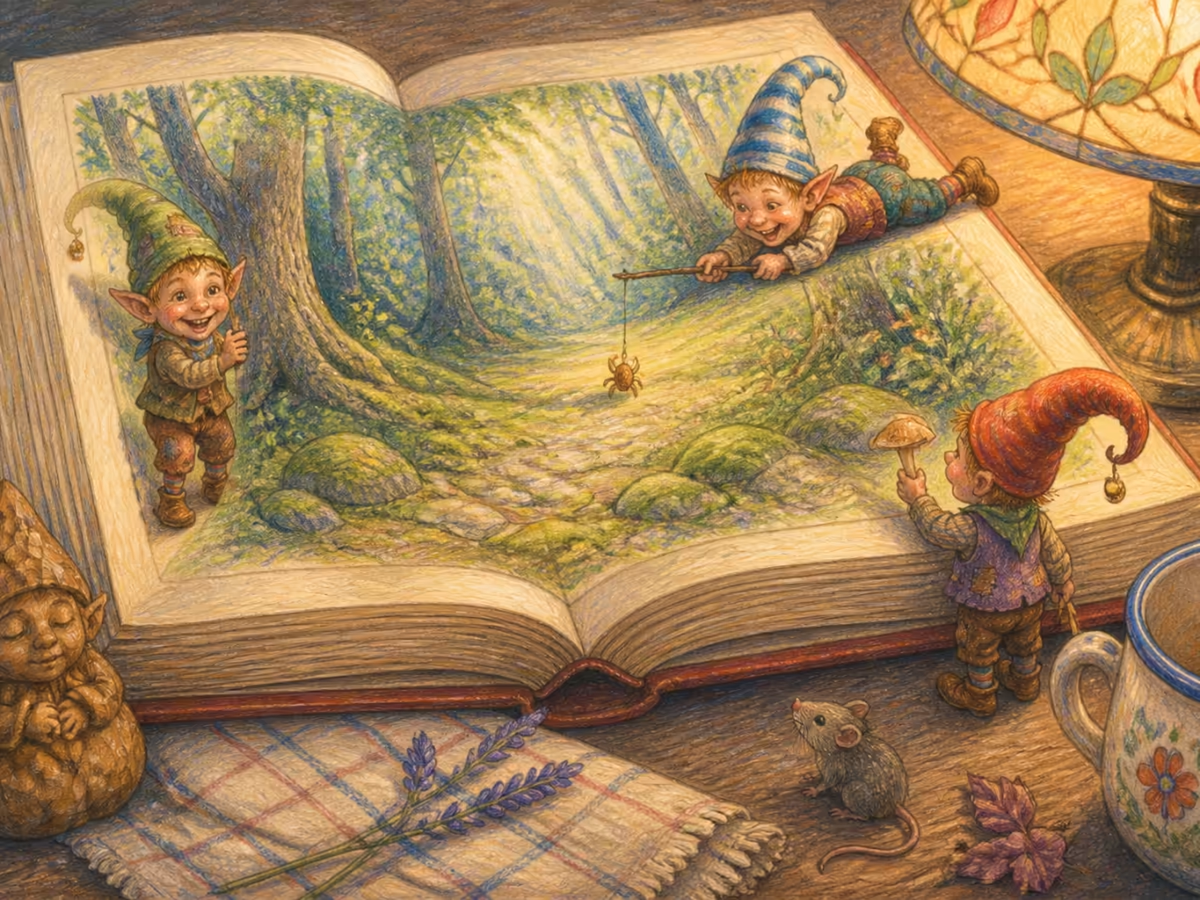
One small piece of advice that experienced storytelling parents share with new parents: choose the bedside figure carefully, and let it stay on the shelf for years. The figure becomes a fixed point of the bedtime ritual, the same small character witnessing hundreds of stories, accumulating its own quiet significance in the child’s memory.
Years later, when the child is grown and you give them back the figure as a young adult, they will recognise it instantly and the memory of every bedtime story it witnessed will return to them in a single warm wave. We Magikitos have seen this happen many times across generations.
How do you choose handcrafted figures to accompany stories?
By three criteria that work in combination. First criterion: durability. The figure will sit on a child’s shelf for years and survive dust, small impacts, occasional drops, and the gentle handling of small hands. Choose carved wood (lime, beech, or maple), felted wool, or fired ceramic, all of which age well. Avoid plastic, brittle resin, or anything with small detachable parts. Second criterion: character. The figure should have an expression and posture that suggest a personality the child can interpret. A perfectly bland figure invites no relationship; a figure with character invites story. Third criterion: scale and tactility. The figure should fit comfortably in a small hand (8 to 15 centimetres is the sweet spot), have a pleasant texture, and feel solid without being heavy. We Magikitos work with Carmen at her workshop in Taramundi, who shapes bedtime figures with exactly these three criteria in mind. You can browse our selection in the fairies collection for the most popular characters, and in our treasures for smaller pieces that pair beautifully as ensemble.
A handcrafted bedtime figure is not a toy. It is the physical witness of hundreds of stories. Choose it as carefully as you would choose a piece of furniture meant to last twenty years.
The Magikitos, from the workshop in Taramundi
Can you create your own magical bedtime stories?
Yes, and it is much easier than most parents think. The formula for a workable improvised bedtime story is straightforward: pick a small creature (a brownie, a fairy, a mouse, a hedgehog), give it a name (Tom, Lily, Hazel, Pip), put it in a familiar setting (a kitchen, a garden, a forest), give it a small problem (a missing object, a stuck door, a lost friend), describe slowly how the creature investigates, and resolve the problem with a small act of kindness or cleverness. End by the creature settling down to sleep. The whole structure can be done in five to ten minutes with no preparation. After three or four attempts, you will find your own rhythm and your own recurring characters.
A useful technique is to maintain a small cast of recurring characters across many improvised stories. After a few weeks, you and your child will have a shared private mythology: Tom the brownie always loses his hammer, Lily the fairy always solves problems with patience, Pip the mouse always finds the missing cheese. This recurring cast becomes a precious private vocabulary that you share only with your child, and that you can revisit at any age, even as the child grows older. Some adult children remember the improvised characters their parents created at bedtime decades after the bedtime ritual itself ended. The characters live longer than the rituals, and they pass on into adulthood as small private inheritances.
What is the difference between fairy stories and folklore?
The two terms are often used interchangeably, but a useful distinction can be drawn. Fairy stories (in the modern British sense, post-1850 or so) are usually shorter, more focused on a single character, and aimed at children. They include the Beatrix Potter tradition, the Cicely Mary Barker Flower Fairies, the Enid Blyton books, and most of what is currently classified as children’s fairy literature. Folklore (in the broader sense) refers to the older oral traditions from which fairy stories are eventually drawn: the brownie legends of Scotland, the pixie tales of Cornwall, the leprechaun stories of Ireland, the troll tales of Norway. Folklore is generally less child-focused, more rooted in specific places, and more morally ambiguous than the fairy stories derived from it. For bedtime purposes, the fairy story is the better fit because it has already been pre-processed for younger audiences. For older children and adults, the folklore is the richer ground, with more cultural and historical depth.
The Magikitos workshop draws on both. Our handcrafted characters are based on the folklore (real brownies, real fairies, real pixies of the British and continental European traditions), but the bedtime stories we tell with them are usually in the fairy-story format (shorter, gentler, child-focused). This combination of folkloric authenticity and child-friendly narrative form is one of the things that makes the Magikitos bedtime tradition distinctive, and it is the secret behind why our characters have endured across so many generations of families. We do not borrow, we adapt with respect, and the result is something both old and gentle enough for a child’s bedside in 2026.