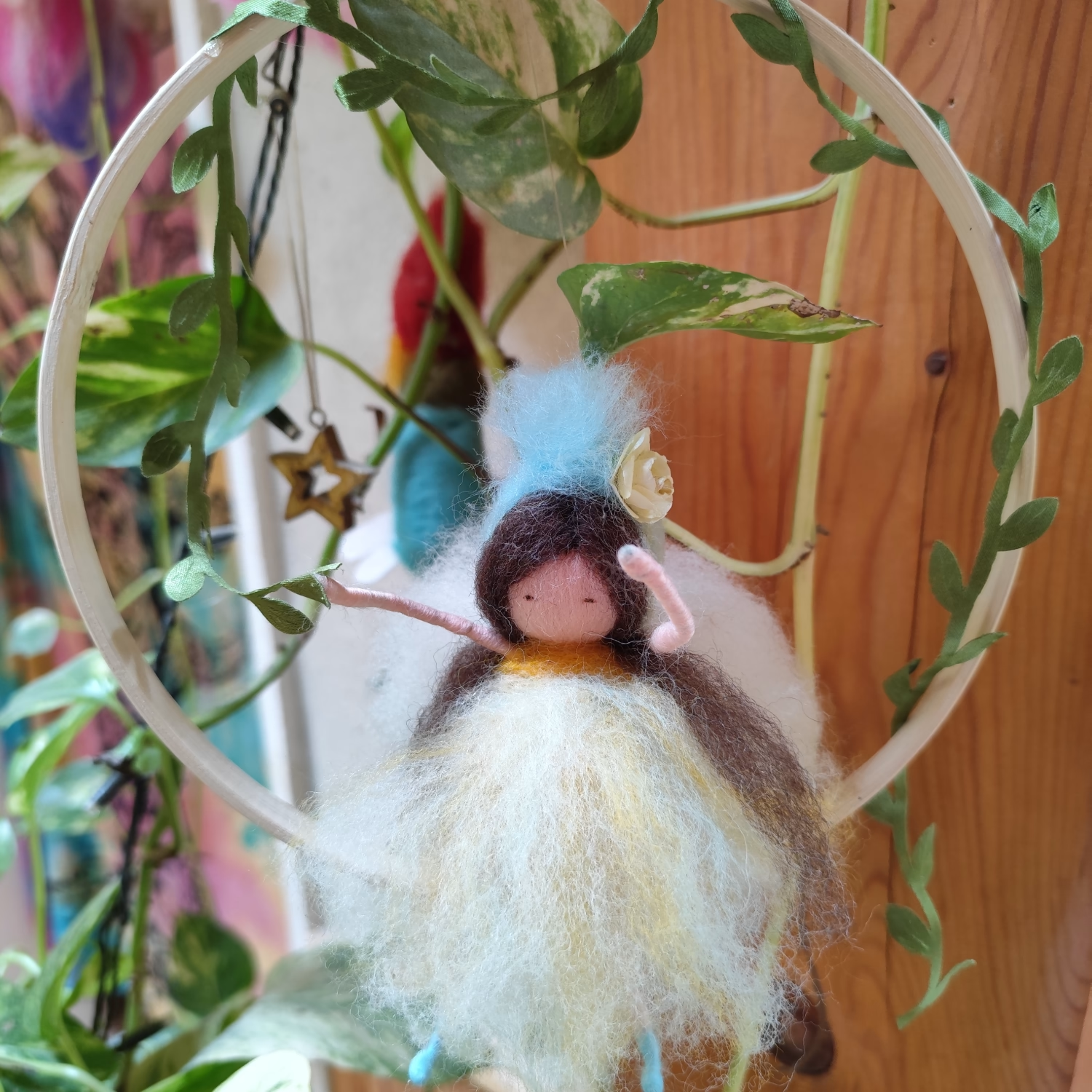
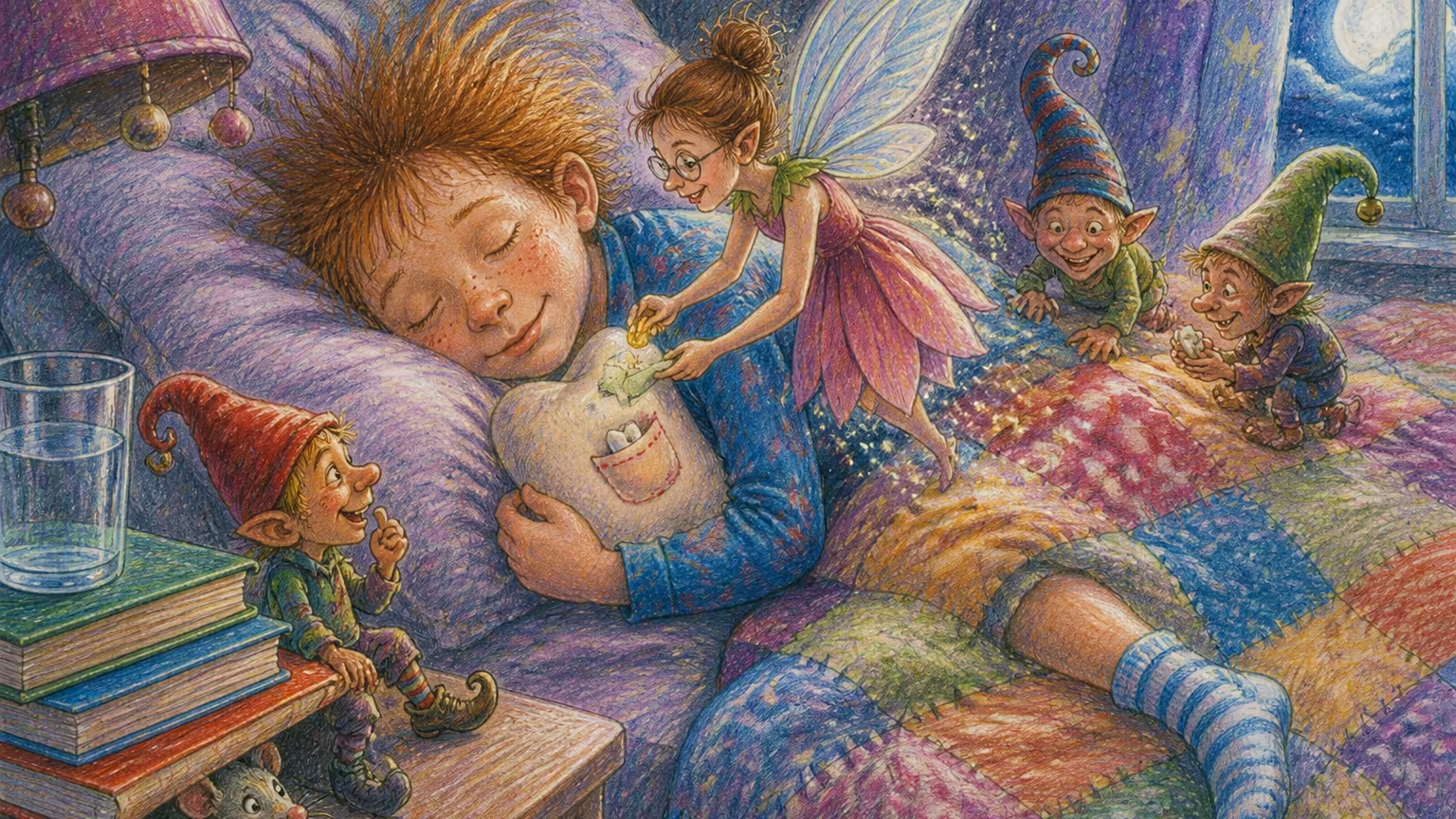
A small child wobbles a tooth for three weeks, finally pulls it out with a piece of dental floss tied to a doorknob (or a cousin willing to risk it), and that night puts it carefully under the pillow before going to sleep. In the morning the tooth is gone, and a coin sits in its place. The child runs to tell the entire household, the parents pretend to be as surprised as the child, and somewhere a slightly sleepy adult is washing a tiny tooth in the bathroom sink because she forgot to dispose of it the night before.
This is the tooth fairy, in the form she has taken in Britain, Ireland, the United States, Canada, Australia and New Zealand for about a hundred years. The story is so familiar that most English-speaking parents have stopped wondering where it comes from. The answer turns out to be much more interesting than the story itself, with roots in medieval Europe, mice in seventeenth-century France, dental disposal rituals from Norse Iceland, and a slow modernisation in early twentieth-century America.
We Magikitos have been telling this story in our workshop for years, partly because it is one of the rare folkloric traditions that is still genuinely alive in the English-speaking world (no marketing required), and partly because it shows beautifully how a folklore can be assembled from multiple older sources. Today the full version: who the tooth fairy is, where she comes from, how she differs from her French cousin la petite souris, what to do with the teeth, and how to keep the magic alive for modern children.
Who is the tooth fairy?
The tooth fairy is a small magical creature, traditionally feminine in English-speaking folklore, who visits children at night when they have lost a baby tooth, takes the tooth from under the pillow, and leaves a small reward in its place (typically a coin, sometimes a small gift, in some traditions a written note). The figure exists in some form in most English-speaking countries (Britain, Ireland, the United States, Canada, Australia, New Zealand, South Africa), with significant regional variation in the details. The tooth fairy is unusual in folkloric terms because she is almost entirely an English-language creature, with no real equivalent in most other European languages. France has a mouse, Spain has a mouse, Italy splits between a little fairy and a mouse depending on the family, Germany has no single clear figure. The English-speaking world is more or less alone with its fairy.
The tooth fairy belongs to the broader family of British fairies, but unlike most of her cousins, she is friendly, gentle, and exclusively focused on a single human ritual. She is not a household helper like a brownie, not wild like a pixie, not a place-spirit like a hob. She is a service-creature, in the most affectionate possible sense: she shows up once when needed, performs her small magic, and leaves.
Where does the tooth fairy come from?
From the fusion of three older folkloric streams in early twentieth-century America. The first stream is the medieval European practice of disposing of baby teeth ritually rather than just throwing them away, a practice documented in records from at least the thirteenth century in northern Europe. Teeth were burned, buried at the root of a tree, or thrown into a particular well, all to prevent witches and bad spirits from finding the tooth and using it for hostile magic. The second stream is the seventeenth-century French story of la bonne petite souris (the good little mouse), first published in print in 1697 by Madame d’Aulnoy, in which a fairy disguised as a mouse helps a queen by hiding under the pillow of an evil king and pulling out his teeth one by one. The third stream is the older Northern European tradition of the tann-fé (the tooth fee), recorded in Norse Iceland by the thirteenth century, where parents paid children a small fee for their first lost tooth as part of an initiation into adolescence.
These three streams, well-known to American immigrant families in the early twentieth century, gradually fused into a single figure in the United States between roughly 1900 and 1950. The earliest known printed reference to the tooth fairy as a unified figure appears in 1908 in the Chicago Daily Tribune household column. The modern figure (a feminine fairy who takes teeth and leaves coins) was widely established in American households by the 1930s, and the tradition then spread back to Britain and across the English-speaking world. The tooth fairy is therefore primarily an American synthesis of older European elements, exported globally through American media in the twentieth century.
How does the tooth fairy tradition work?
In four simple steps that have remained almost unchanged for nearly a century. First, the child loses a baby tooth, either naturally or with parental help (the doorknob method, the tied-string method, the wiggling-for-days method). Second, the tooth is cleaned, sometimes wrapped in a tissue or placed in a small tooth-shaped pillow or pocket that some families maintain across generations. Third, the tooth is placed under the child’s pillow at bedtime, with the explicit knowledge that the tooth fairy will visit in the night. Fourth, in the morning the tooth has been replaced by a small reward, typically a coin, sometimes a small gift, sometimes a written note from the tooth fairy explaining her work. The cycle then resets for the next tooth, which usually arrives within weeks to months.
What is the difference between the tooth fairy and France’s petite souris?
Significant differences in form and minor differences in function. The Anglo-American tooth fairy is, as the name says, a fairy, with all the visual and folkloric implications: feminine, winged, beautiful, magical, with vague but glowing imagery. The French petite souris is a mouse, with all the very different implications: small, four-legged, brown, agile, hidden in walls and floors, but no less magical for being entirely non-anthropomorphic. The function is identical in both traditions (taking the tooth, leaving a coin or small gift in its place), but the cultural backdrop is completely different. The fairy in the English-speaking world fits a broader culture of fairy-related children’s literature (Peter Pan, Tinkerbell, A Midsummer Night’s Dream), while the mouse in France fits a long tradition of small-creature folklore (le Roman de Renart, fables de La Fontaine, the older bonne petite souris of Madame d’Aulnoy).
What’s particularly interesting from a comparative folklore perspective is that the two figures derive from the same seventeenth-century French source (the d’Aulnoy story of 1697), but they diverged in opposite directions over the next two hundred years. French popular culture kept the mouse form, while Anglo-American culture transformed the mouse into a fairy. We don’t know exactly why, but the most plausible explanation is that the English-speaking adoption of the tradition in the early twentieth century coincided with a strong cultural enthusiasm for fairies (the Cottingley case of 1917-1920 is part of this enthusiasm), which made fairy-form more attractive to the imagination of American parents.
When did the modern tooth fairy story start?
The modern figure crystallised in the United States between roughly 1900 and 1950, with key documented milestones along the way. 1908 saw the first known print reference to the tooth fairy as a unified figure (Chicago Daily Tribune household column, written by Lillian Brown). 1927 saw the publication of the first dedicated tooth fairy book, an eight-page playlet by Esther Watkins Arnold called The Tooth Fairy, which fixed many of the visual conventions still used today. 1949 saw the publication of a much more influential children’s book, The Tooth Fairy by Lee Rogow, which spread the figure into elementary schools across America. By the 1950s, the tooth fairy was firmly part of American childhood folklore, and by the 1960s the tradition had been exported back to Britain and Canada, where it largely replaced or supplemented older local customs. By the 1980s it had reached Australia and New Zealand, and by the 2000s it was firmly established in most English-speaking countries.
Curiously, the tooth fairy has had a much slower expansion into non-English-speaking countries. Despite the global reach of American children’s media, the tooth fairy remains largely an Anglosphere phenomenon, with France, Spain, Latin America still preferring their respective tooth-taking mice, and most of central and eastern Europe still preferring their respective regional variants or no specific tradition at all. The tooth fairy is therefore a useful case study in the limits of cultural globalisation: even Hollywood cannot easily replace a deeply-rooted local figure.
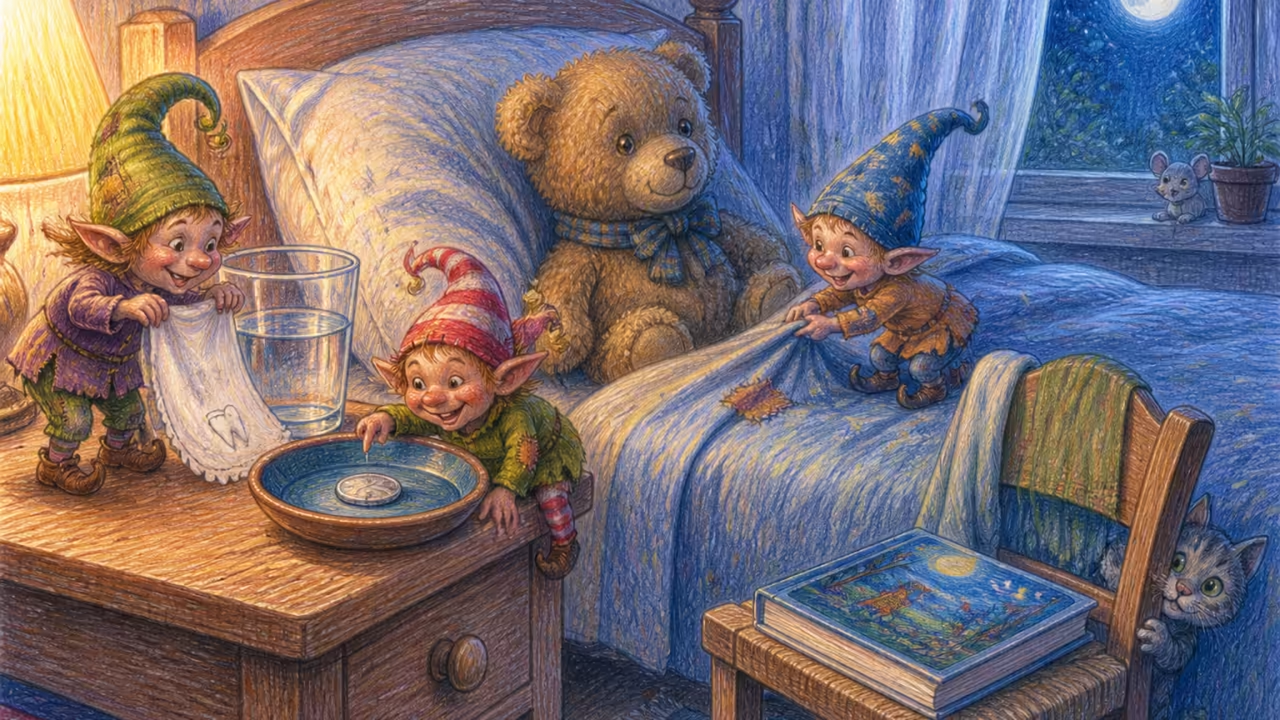
How much should the tooth fairy leave?
The amount varies enormously by country, by family, and by year. In Britain, the most common amount in the 2020s is between one and two pounds per tooth, with some families giving up to five pounds for the first lost tooth and one pound for subsequent ones. In the United States, the average amount as documented in the annual Delta Dental Tooth Fairy Index has risen from about one dollar in 1998 to between four and six dollars in 2024, with significant regional variation. In Canada and Australia, amounts tend to follow the British model more than the American. In Ireland, amounts are typically between one and three euros, depending on family tradition. The general principle is that the first tooth gets a slightly larger reward than subsequent teeth, as a way of marking the special nature of the first one, and that the reward should be a small symbolic amount rather than a large financial transaction.
Our Magikitos recommendation: aim for symbolic, not generous. A coin that the child can hold in their hand is more magical than a banknote that immediately goes into a parent-managed savings account. The tooth fairy is not Father Christmas, she is a small witness to a small physical milestone, and her reward should match that scale.
How do you make the tooth fairy ritual magical for kids?
With five small additions that take very little effort but transform the experience. First, a dedicated tooth pillow or pouch, ideally handmade or inherited from a family member, where the lost tooth goes before being placed under the sleeping pillow. The pillow becomes a small treasured object that the child looks forward to using, and that can later be kept as a memento. Second, a small written note from the tooth fairy, two or three lines on a tiny scrap of paper, ideally signed with a small drawing rather than a name. The notes are often kept for years and become a small family archive. Third, fairy glitter (a tiny amount of biodegradable glitter sprinkled near the pillow and the coin), a visual confirmation that something magical has happened during the night. Fourth, slightly larger coins (a fifty-pence piece in Britain, a half-dollar in the US, a two-euro coin in Ireland) which feel weightier and more special than regular small change. Fifth, a tooth fairy bell or door, an optional small object (a tiny bell hung near the bed, a small wooden door fixed at floor level) which marks the bedroom as a place she can visit.
None of these additions are strictly necessary. The basic four-step ritual works perfectly well without them. But each addition deepens the experience for the child, and for some families they become the most cherished part of the tradition.
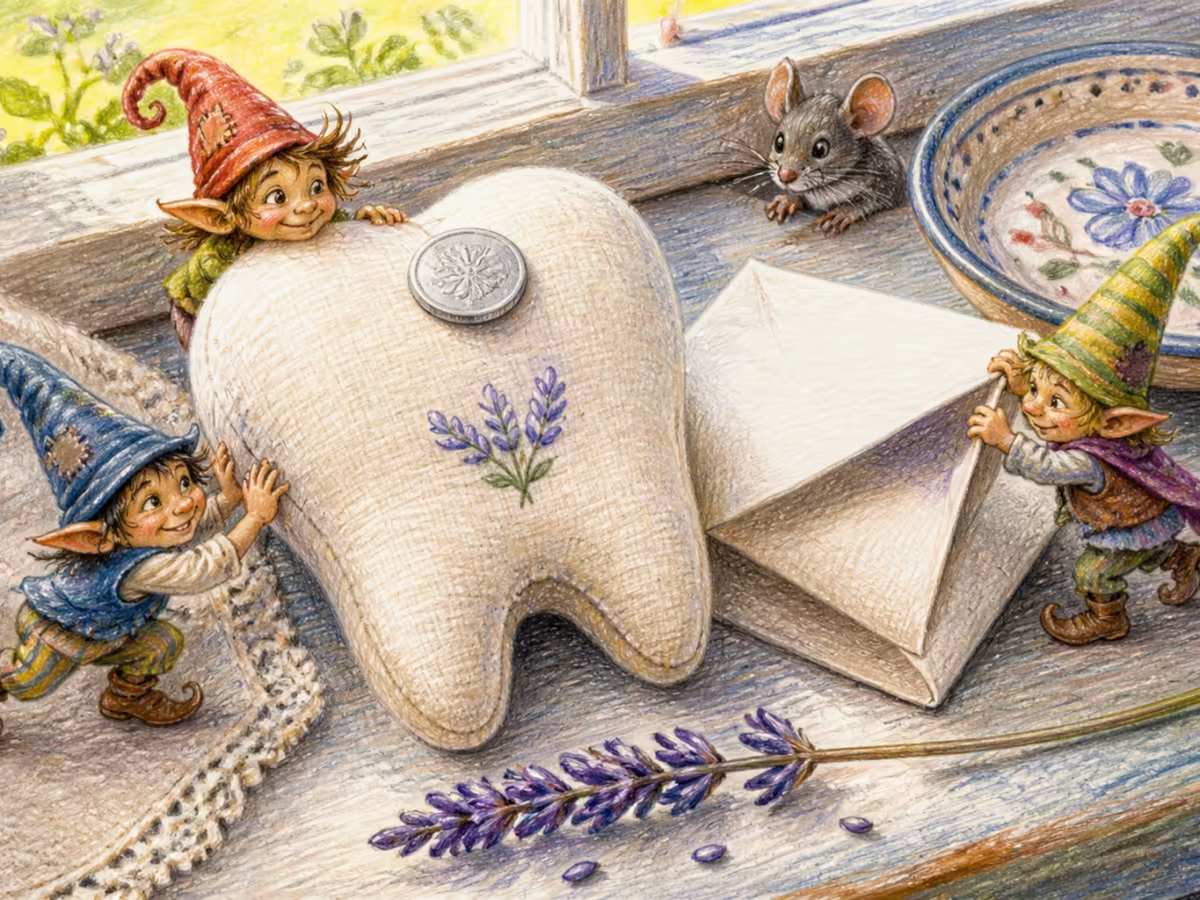
One of the most beautiful customs we Magikitos have observed in tooth fairy families is the slow accumulation of tiny written notes from the fairy over a child’s lost-tooth years. By the time the child has lost all twenty baby teeth (typically between ages five and twelve), the family has a small collection of twenty hand-written notes, each tied to a specific moment in childhood.
Keep these notes in a small wooden box or a folded handkerchief, labelled by date and tooth-number. Years later, when the child is grown, this box becomes one of the most precious heirlooms of the family archive.
What do parents do with the lost teeth?
Different families have very different practices, and the question is one of the more genuinely interesting variations across the tooth fairy tradition. The most common practice is private parental disposal: the parent collects the tooth from under the pillow during the night, washes it, and discards it discretely (in the rubbish, down the sink, or sometimes buried in the garden following the older European disposal practice). The second most common practice is parental keeping, where the parents collect the teeth into a small jar or container, kept hidden, sometimes given to the child years later as a slightly strange but touching memento. The third practice, less common but increasingly mentioned, is ceremonial disposal: burying the teeth in the garden, throwing them off a bridge into running water, or planting a small tree marked with the position of each buried tooth. The fourth practice, primarily found in older Eastern European traditions imported into Anglo-American culture, is throwing the tooth onto the roof of the house at sunrise, a practice associated with the Scandinavian and Slavic immigrant communities of nineteenth and early twentieth century America.
From a Magikitos point of view, all four practices are legitimate, but we have a small preference for the ceremonial garden burial. It echoes the medieval European root-of-tree disposal practice, it gives the family a small ritual that ages well over years, and it leaves a small visible trace of childhood in a specific place. Some Magikitos-aligned families plant a small spring-flowering bulb (snowdrop, crocus, daffodil) over each buried tooth, creating a small garden of childhood teeth that flowers each year as a quiet memorial.
The tooth fairy is the only fairy in English-language folklore whose job description is exactly one sentence long. That economy of purpose is what has kept her alive for a hundred years.
The Magikitos, from the workshop in Taramundi
Where can you find handmade tooth fairy keepsakes?
From small craft workshops, embroidery shops, and a handful of specialised online makers. The British and Irish craft scene has a particularly strong tradition of handmade tooth fairy pillows (in linen, cotton, or wool felt), with embroidered initials and small tooth-shaped pockets. The American scene leans more towards quilted fabric pouches, sometimes with small printed designs. The Australian scene has produced some excellent contemporary takes. We Magikitos love this little craft world. In our treasures collection we gather small handmade keepsakes that pair beautifully with the ritual, and our fairies collection is there for families who want to deepen the fairy-themed aesthetic of the bedroom.
One small thoughtful gift idea for grandparents or aunts: a tooth fairy pillow embroidered with the child’s name and date of birth, given as a christening or first-birthday gift. By the time the child is five and starts losing teeth, the pillow has been waiting on a shelf for years, and the ritual gains an extra layer of family history.
Does the tooth fairy still work for kids in the digital age?
Yes, perhaps more strongly than ever, and for an interesting reason. Modern children’s lives are dominated by screens, scheduled activities, and digital media, but the tooth fairy ritual is stubbornly analogue: a physical tooth, a physical pillow, a physical coin, a physical note. In a generation that experiences most of its rewards through pixels, the tooth fairy delivers something three-dimensional, weighted, smelling slightly of paper or fabric. This sensory anchoring is psychologically powerful for children, and many child development researchers have noted that traditions like the tooth fairy seem to have become more important rather than less in the digital age, precisely because they offer something that screens cannot.
The other reason the tooth fairy survives today is that she has no commercial incentive working against her. Unlike Father Christmas, Easter Bunny, and Saint Valentine, none of whom can be celebrated without a wave of merchandise sales, the tooth fairy is remarkably free of commercialisation. There are no tooth fairy adverts on television, no tooth fairy themed sweet aisles in shops, no tooth fairy seasonal merchandise. She remains a domestic, private, family-internal tradition, which paradoxically gives her enormous staying power. Long after some of the other holiday figures have been worn down by overexposure, the tooth fairy is likely to remain quietly active under pillows across the English-speaking world. Long live the small magic that never made it into a marketing budget.