In Asturias, if stuff keeps slipping off the table, it’s not that you’re clumsy. It’s the Trasgu. That’s it.
Not joking. Up in northern Spain there’s a tradition of magical creatures that’s so rich, so old, and so rooted in everyday life that it doesn’t need fantasy books to “exist”. It lives in the stories grandmas tell their grandkids. In the names of springs, rivers, and caves. In the way people talk about the woods when the fog rolls in.
So today we’re telling you who the northern creatures are. The real ones. The ones that have been here way before us.
The Trasgu: king of the house
Let’s start with the boss. The Trasgu is the classic Asturian house Brownie. The most loved, the most famous, and probably the most mischievous creature in all Iberian folklore.
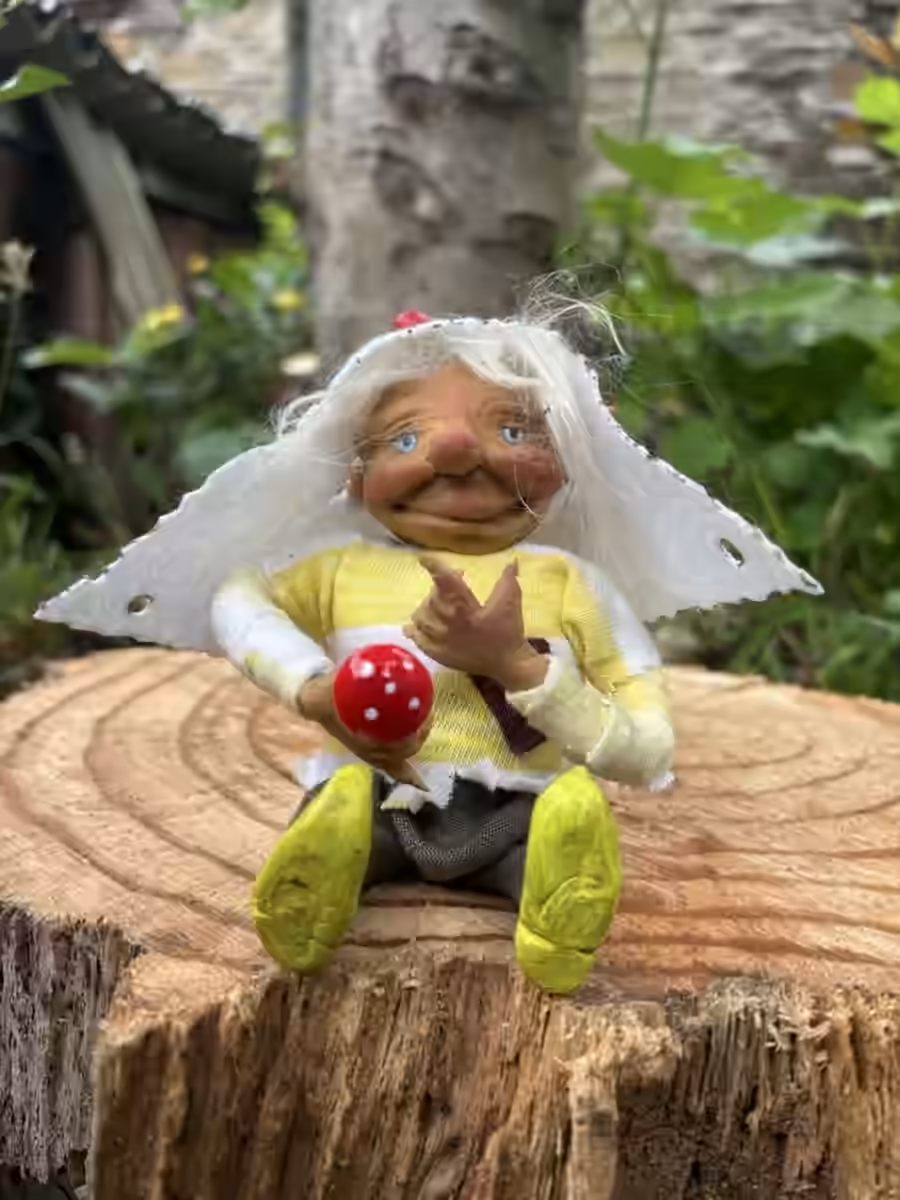
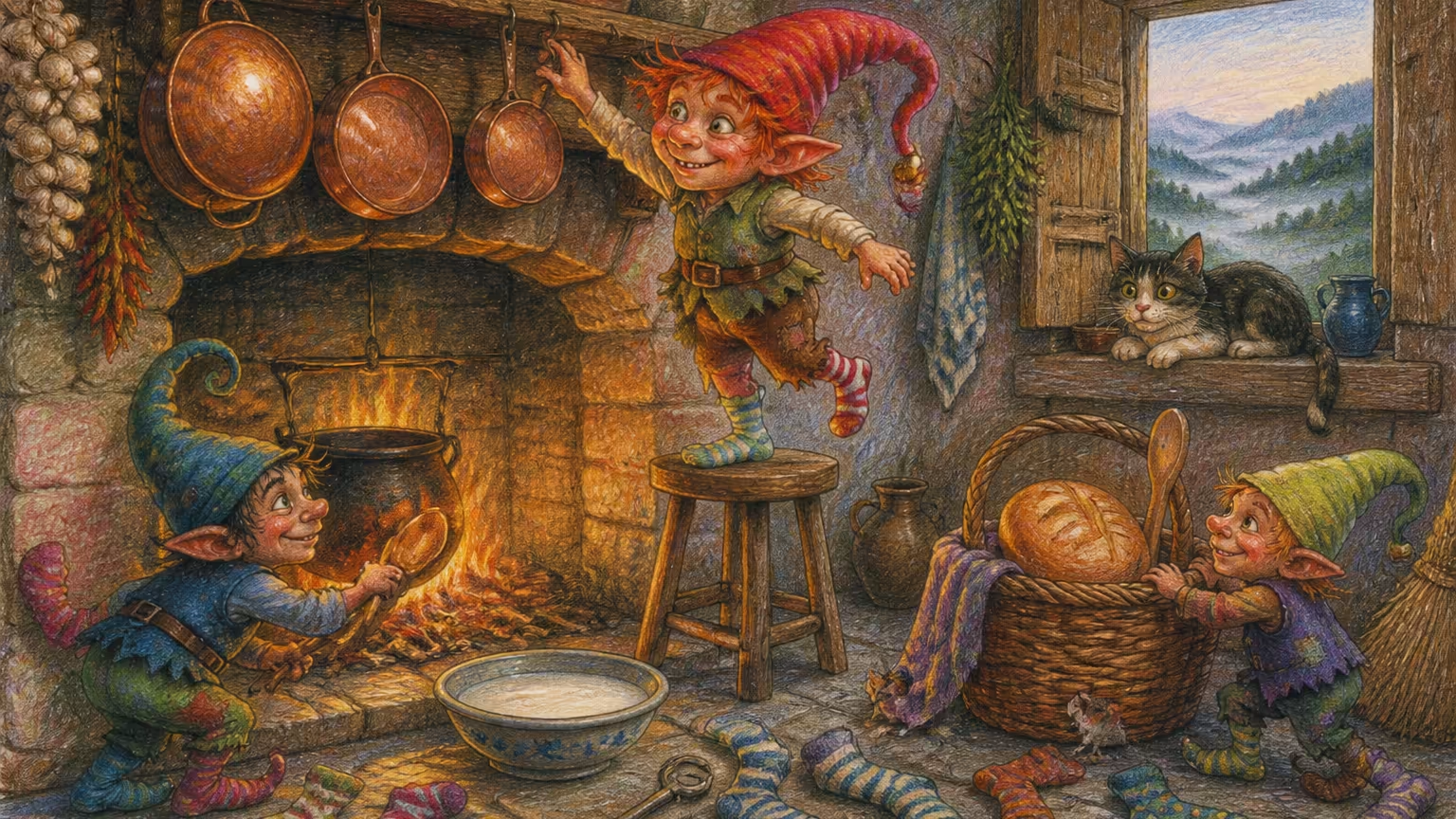
You can’t mistake him: wee (doesn’t even reach a meter), red-haired, with a pointy red cap, and a limp in his left leg. Always grinning. Always up to something.
The Trasgu lives in houses. He moves in without asking, like that roommate who never pays but somehow you end up attached. And from there, he runs his own little kingdom of domestic chaos:
- He hides keys, remotes, and socks, especially socks
- He “accidentally” breaks plates and glasses, always “accidentally”
- He makes noises at night that wake you up right when you were about to drift off
- He nudges furniture just enough for you to smash your little toe
- He messes up what you literally just tidied
But hey, the Trasgu has a good side too. When he likes you, and especially when you leave him a bit of milk by the fire, he’ll tidy the kitchen at dawn, look after the animals, and keep an eye on the house at night. He’s a good guy. A bit intense, but a good guy.
The limp matters. In the old stories, the Trasgu limps, so he can’t do certain tasks that need balance. If you want him gone, which we don’t recommend, ask him to fill a basket full of holes with river water, or to pick up millet grains scattered on the floor. Between the limp and his impatience, he can’t finish. He gets fed up and leaves.
Then he comes back. He always comes back.
If you’ve already read about the tradition of house Brownies across Europe, you’ll spot it straight away: the Trasgu is basically a close cousin of Scottish Brownies and German Kobolds. Same job, same deal, same obsession with hiding things. European folklore shares more DNA than we think.
The Xana: the water fairy
If the Trasgu is king of the house, the Xana is queen of the waters. And honestly, she’s the most beautiful creature in Asturian folklore, no contest.
The Xana (pronounced “shana”) is a female spirit who lives in springs, rivers, waterfalls, and water-filled caves. She’s stunning, with long golden hair, and a voice that gets under your skin. Up to here, it could sound like a Greek nymph or a northern siren. But the Xana has a very Asturian vibe of her own.
She combs her golden hair with a comb of gold and silver by the water. If you find that comb, you’ll have good luck, but only if the Xana gives it to you willingly. Stealing it is basically begging for trouble.
Xanas also guard treasures under the water. Gold, jewels, magical objects. Getting to them means passing tests of courage and kindness. The Xana shares her riches with people who deserve it. No shortcuts.
The loveliest thing about the Xana stories is this: every spring in Asturias has its own. It’s not some generic legend. Every village, every river, every source has specific tales about its particular Xana. With her own name, her own little anecdotes, details that have been handed down for centuries.
On St John’s Eve, they say the Xanas come out of the water to dance and comb their hair under moonlight. If you see them that night, you’ll be enchanted forever. Sounds romantic, sure, but in Asturias people celebrate St John with bonfires by the rivers. Traditions don’t just show up for no reason.
The Nuberu: lord of storms
If there’s one thing Asturias knows, it’s rain. And storms. And skies that turn black in five minutes. For all that, there’s a name: the Nuberu.
The Nuberu (also called Nubero or Reñubeiru) is the spirit of clouds and storms. He lives in the clouds, rides on them, and he’s the one who decides when it rains, when it hails, and when a lightning bolt hits the oldest oak in the village.
What he looks like changes depending on who’s telling it. Sometimes he’s a bearded giant dressed in hides. Sometimes he’s just a regular man with a massive hat. Sometimes you don’t see him at all, you only hear him in the thunder. But his personality stays the same: moody, unpredictable, and seriously bad-tempered.
Those summer storms that arrive out of nowhere and ruin the crops, that was Nuberu business. Asturian farmers had ways to calm him down: ringing church bells during the storm, the sound was said to scare him off, burning laurel branches, or putting a broom upside down by the front door.
There’s a version of the legend where the Nuberu is an Asturian who went to study magic in Salamanca, the university had a reputation for teaching hidden arts, and came back with power over the weather. Another version says he was born from a storm, and to a storm he’ll return when the world ends. Complicated character, basically.
The Busgosu: protector of the forest
If you head deep into Asturias’ woods, the kind where the chestnut trees are so old they look like they’ve got faces, you might run into the Busgosu.
The Busgosu is half man, half goat. Horns, goat legs, a human torso, and thick fur covering almost all his body. He lives in the deepest part of the forest, and his job is to protect it.
Unlike other folklore beings who deal with humans, the Busgosu prefers to avoid them. He’s not aggressive, but he’s not exactly friendly either. Walk into his forest with respect and he’ll let you pass. Walk in to cut trees for no reason, light fires where you shouldn’t, or hunt more than you need, and you’ll have problems. Paths that vanish. Sudden fog. Sounds that throw you off. The Busgosu doesn’t attack. He just gets you lost until you decide to leave.
He’s the quiet guardian. The one who watches the forest when nobody’s looking. A bit like Magikitos, who look after your home from their shelf without making a fuss. The difference is the Busgosu is two meters tall and has horns. Same idea though: protect what matters.
The Guestia: the procession of souls
And now we’re getting to the part that makes you swallow a little. Because not everything in Asturian folklore is cute and cheeky. Some of it gives you proper chills.
The Guestia (or Santa Compaña in Galicia) is a procession of restless souls that walks the rural roads at night. They move in a line, carrying lit candles, whispering prayers, and slowly making their way along the country paths.
The tradition says that if you run into the Guestia, there are rules, very strict ones:
- Don’t look at them straight on. Turn your eyes away and let them pass.
- Don’t accept anything they offer. If someone in the line hands you a candle, don’t take it or you’ll join them.
- Draw a circle on the ground and stand inside. Inside the circle you’re protected.
- Lie face down. The procession will pass over you without seeing you.
The Guestia is the Iberian cousin of the “Wild Hunt” you find all over Europe, the Germanic Wild Hunt, the French Mesnie Hellequin. Same idea: a spectral night procession roaming the roads. And the same quiet lesson underneath: at night, out in the countryside, you’re better off at home.
Unlike the Trasgu or the Xana, the Guestia isn’t friendly. You don’t bargain with it. You don’t leave it milk. There’s no sweet side to it. It’s a reminder that the magical world isn’t only cheeky Brownies and pretty fairies. It has shadows too. And that respect for the unknown is part of the folklore.
The Cuélebres: Asturian dragons
Yep, Asturias has dragons too. Well, gigantic winged snakes. Same thing really, just with an Asturian accent.
Cuélebres are enormous serpents with bat-like wings, guarding treasures and caves. They live in the hardest-to-reach mountains, sleep for years, and when they wake up, they’re hungry in a way that’s not easy to fix.
The most famous Cuélebre story is the cave of Covadonga. The old tale says that before the Virgin appeared there, the cave was guarded by a Cuélebre. The first Christians who arrived had to face the serpent before they could set up their sanctuary.
Cuélebres stand for untamed nature, the raw power of Asturias’ mountains. They’re the opposite of the homely Trasgu. If the Trasgu is the house Brownie, the Cuélebre is the mountain beast. And in folklore, you kind of need both.
The Sumiciu: the one who gets you lost
This one’s less famous, but it’s a gem. The Sumiciu is a forest spirit whose only job is to mess with your sense of direction.
Ever walked a path you know like the back of your hand and suddenly had no idea where you were? Ever turned the way you were sure was right and ended up on the other side of everything? In Asturias, there’s an explanation: the Sumiciu.
The Sumiciu doesn’t hurt you. It doesn’t chase you, attack you, or threaten you. It just scrambles you. It shifts your landmarks. It shows you paths that aren’t there and hides the ones that are. When the Sumiciu’s at work, the forest you knew turns into a maze.
To shake the Sumiciu off, tradition says you should put your clothes on inside out. Sounds ridiculous, but it’s got that old magical logic: flip your clothes, flip its trick. The woods settle down, and the path shows up again.
Brilliant, right? Northern Spain is like that. There’s a fix for everything, even if the fix is taking your shirt off and putting it back on the wrong way round.
Why does Taramundi tie it all together?
And in the middle of this whole universe of creatures, there’s a place where the tradition hits extra hard. Taramundi.
Taramundi isn’t just any Asturian village. It’s a place where handcrafted knife-making goes back centuries, where chestnut woods are so old they feel like they remember things, and where the fog behaves like it’s got a mind of its own. In our Taramundi section you can get to know this special corner a bit better.
Carmen chose Taramundi as the spiritual home of Magikitos for a reason. It’s where the artisan tradition, knives, blades, working with your hands, blends with the magical tradition, the Trasgu, the fog, the forests. Making things by hand and believing in the magic around you aren’t two separate worlds there. It’s the same world.
When you hold a Magikito in your hands, you’re holding a little piece of all this. The Trasgu and his grin. The Xana and her secrets. The forest and its whispers. Taramundi and its story.
Why do these creatures still matter today?
We live in a world that’s decided magical creatures are “kid stuff”. That folklore is an old distraction that doesn’t do anything anymore. That the only real reality is the one you can measure with a device.
Well, look. Those Asturian grandmas telling Trasgu stories weren’t wasting time. They were teaching. Teaching respect for the house, because if you don’t treat the Trasgu well, he’ll make your life a mess. Respect for nature, because if you bother the Busgosu, you’ll get lost. Respect for cycles, because the Xana comes out on St John’s Eve, not whenever you feel like it. Respect for death, don’t look at the Guestia, don’t touch what isn’t yours.
All the folklore of northern Spain is, at heart, a how-to guide for living with the world. With the house, the forest, the water, the night. Told as stories because that’s how it sticks.
Magikitos are part of that tradition. They don’t replace it. They don’t copy it. They don’t turn it into a sales pitch. They keep it going. With respect, with affection, and with that cheeky little smile that says the magic hasn’t gone anywhere.
You just have to look a little closer.