
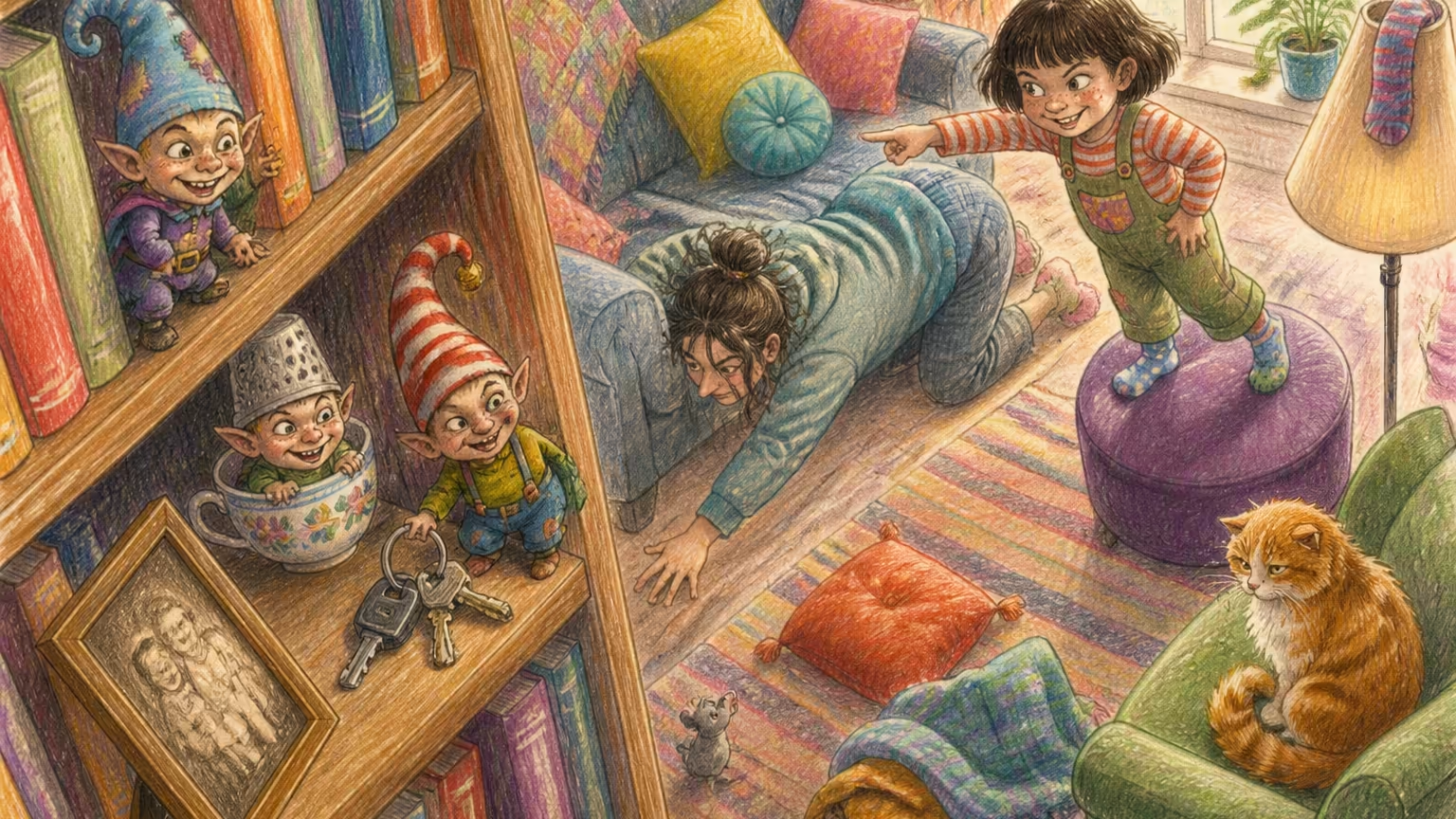
Somewhere in your home, right now, there is something you cannot find. Keys, most likely. Or the remote. Or that charger that was definitely, absolutely, one hundred per cent right here.
Six thousand years of human civilisation have grappled with exactly this mystery. Today, we come clean.
How long have Brownies been moving things around?
As long as there have been homes to move things in. Which is the honest answer, even if it is not the convenient one.
The Scottish Brownie has been a documented presence in household lore since at least the sixteenth century, and the moving of objects was always part of the arrangement. The German Kobold hid tools in barns across the Middle Ages. The Italian Folletto has been historically responsible for a startling proportion of lost reading glasses on the Italian peninsula. The French Lutin preferred horse manes, but when no horses were available, a desk full of papers worked equally well.
Here is what makes this genuinely interesting: none of these traditions borrowed from each other. They emerged independently, across cultures that never compared notes, from the Scottish Highlands to the mountains of Asturias to the Italian Alps. Every civilisation that lived close to the land independently invented small household creatures that moved your things around. That is not coincidence. That is a pattern. And patterns, as we have observed over rather a long time, tend to mean something.
The full history of how this tradition developed across Europe is in our article on household Brownies through history. Worth the read.
Why does the same pattern appear in every culture?
This is the question researchers have been working on for decades. As the creatures directly involved, we have a particular perspective on it.
The academic answer: lost objects produce anxiety, and attributing them to an external creature makes that anxiety manageable. Instead of "I am a person who loses things", you get "it was the Brownie, who treats every drawer in the house as a personal sesh gremlin playground". Psychologically healthier. Culturally validated across six millennia. We are, in our own way, a public service.
Our preferred explanation goes a step further.
When you look for something, you stop. You look around. You actually see your home. You pick up that book you have been meaning to read, find that note from two years ago, discover the thing under the sofa whose existence you had completely forgotten. A missing key is not an inconvenience. It is an involuntary audit of your own living space. A forced moment of attention in a home you have been walking through on autopilot for months.
We call this the Perceptual Reorganisation Service. It is not a vanishing act. It is a reminder system.
Is there a hierarchy in what goes missing?
Yes, and folklore documents it with impressive consistency across all traditions we have had the pleasure of being part of.
Category One: keys, odd socks, pens. High frequency of use, low emotional stakes. The classic entry-level disappearance. Produces a five-to-ten-minute search and a muttered comment to nobody in particular.
Category Two: remote controls, reading glasses, chargers. Minimum fifteen-minute search, full sofa cushion redistribution, first round of family accusations. The intermediate level.
Category Three: the book you were sure you had, the receipt you definitely saved, the specific object whose absence generates a genuine philosophical conversation about whether you ever owned it at all. Advanced. Reserved for specific circumstances. The criteria are confidential.
What is the Cosmic Mischief Theory, and why does it matter?
We are glad you have made it this far, because this is the important part.
The Cosmic Mischief Theory, or CMT, proposes that domestic chaos is not random but intentional and, at its core, kind. Not entropy. Choreography. The universe, operating through its smallest and most cheerful agents, introduces minimal perturbations into daily human routine to produce exactly the quantity of conscious attention the moment actually requires.
When you cannot find your keys at eight in the morning, the CMT suggests the universe has decided that particular morning required two minutes of active searching before you left the house. Perhaps to cross paths with someone. Perhaps to miss a specific traffic light. Perhaps simply to lift your head out of autopilot for thirty seconds and actually notice where you live.
Scientific proof? None that would satisfy a committee. Six thousand years of consistent cross-cultural folklore pointing in the same direction? Absolutely. The CMT is the only explanation that does justice to the actual scale of the phenomenon.
For everything else we get up to when you are not watching, our secret life has the details. Fair warning: the schedule is busier than you might expect.
The keys will turn up. They always do. In the meantime, have a look at that shelf where your Magikito lives. Ask, calmly and without accusations, where they have got to. Communication is the key to everything. Including the one for your front door.