
It’s Eva
She was three hundred metres away and the whole village knew

“Morning. Can I have my ladder back?”
At eight on the morning of the sixth day, Úrsula turned up at the door in her work overalls.
“The ladder?”
“The aluminium one, lad. I need it.”
“Oh. Yeah, course. It’s upstairs, I’ll bring it down.”
Úrsula didn’t move from the step.
“At my house.”
“What?”
“Eva.” She shoved her hands in her overall pockets. “She’s at my house. She came back on Friday.”
Axel stood there with his hand on the door frame.
“At your house?”
“Three hundred metres from here. In the green house.”
“Úrsula, I’ve spent five days looking in ditches.”
“I know. I’ve seen you. She told me not to say anything. So I didn’t say anything.”

“Is she all right?”
“She’s on my sofa. Eating, sleeping and not talking. Like a cat that’s been hurt.”
“Look, lad, I don’t get involved.” And she got involved immediately. “But I’ve had a twenty-four-year-old kid in my living room for four days and last night she told me what you did. I’m going to tell you two things and then you give me my ladder back.”
Axel waited.
“The first is you’ve cocked it up. You know that already, it’s written all over your face.”
“Yeah.”
“The second is that you cocked it up the day you didn’t tell her. Not the day you rang.” She took a hand out of her pocket. “Keeping quiet’s one thing. Sending her reports every week is another.”
Axel didn’t answer. He had nothing to say in his defence.
“Right, then. The ladder.”
“And why are you telling me now?”
“Because now she’s told me to tell you.”
She turned to go. Halfway down the hill she stopped, without turning round, and lifted her chin at the roof.
“And you’re going up there today. You’ve gone five days without touching a slate and the order on the door hasn’t moved.”

It turned out the whole village knew: Trini, Sabino, the lad with the frying pans, even the neighbour who hadn’t said good morning to him for two months. Twenty-six people had managed to keep it from him for four days, which in a village of twenty-six is like keeping a secret in a tin of sardines. Trini had taken his money for the bread that very morning without so much as a blink.
He started hauling up slate at nine and kept going until five without coming down to eat, watching the rope and the bend in the street. Then he saw her appear.
Eva came with her backpack over one shoulder and Fay ahead of her, tail held proudly upright. Kika heard her before anyone else, shot down the hill and ran circles round her, howling as though she’d found her after a hundred years.
“Get off, you pest. Get off.” And she crouched down to hug her anyway.
Axel came down the ladder with the bucket still in his hand and didn’t know what to do with the bucket.
“Hi.”
“Hi.”
“Can I come in?”
“It’s your house.”
“No, it’s not my house.” She said it without any bitterness, like a fact. “Can I come in?”
“Yeah. Come in, go on.”

They sat in the kitchen, one on each side of the table.
“Eva, I…”
“Wait.”
“It’s just I want to tell you that…”
“I said wait.”
He shut up.
Eva put both hands on the table and looked at them.
“We’re doing this the other way round. I talk first. And you don’t fix anything for me. Not one sentence, Axel. If you start explaining why you did it, I’m getting up and going.”
“Okay.”
She was quiet for a minute.
“I went to the audition,” she said. “Three hours. It went well. They told me to come back in October and I said no. I came back on a bus and a tractor.”
She told him without looking up from the table.

“Then four days at Úrsula’s. I’ve painted a whole room for her and we haven’t talked about this once, because that woman doesn’t ask. And on Saturday, painting a skirting board, I caught myself waiting.”
“Waiting for what?”
“For you to come up and get me.”
Axel took a breath.
“Shut up.”
He let the air out through his nose.
“For you to come up and talk me round.” She gave a humourless snort. “Like my whole fucking life. Waiting for someone to make it easy for me.”
“Hortensia told me once that anyone who makes you feel you owe them something doesn’t love you. They want to boss you about.” She looked him in the face. “And you did that to me, Axel.”
Axel looked down.
“And in two years I hadn’t said my surname in a single village. In this one I did. In front of a gas bottle, to sign for an envelope.”
She took the insurance envelope out of her backpack. She’d opened it already, and she smoothed the policy out on the table and pointed to a box.
Occupants: 2.
“Two years without me,” she said. “And it says two.”
Axel had known since June. He didn’t say that either.
“And my sister hasn’t been here with me for a single day. Not one. I’m the one carrying her. Everywhere. Like the rucksack.” She laughed. A bit, this time. “Some freedom.”

Axel kept quiet.
“So I’m going to do something,” said Eva. “And I’m going to do it myself. Give me your phone.”
Axel gave it to her. The same one she’d used, six days earlier, to ring someone else.
“Give me the number.”
“Eva…”
“The number, Axel.”
“Are you sure?”
Eva already had her thumb over the screen.
“No. But it’s mine.”
Axel read out nine digits. She typed them in one by one, without getting a single one wrong.

Then she took the tartan blanket off the bench, threw it round her shoulders and went out onto the balcony, which was the only place in the house with a bar of signal.
She tried to close the balcony door, but the frame had been half repaired since July and left a gap four fingers wide. Axel could see her back, the phone in her hand, not yet raised to her ear. Three quiet rings came from her hand.
On the fourth she put it to her ear.
Through that gap, Axel heard the first words Eva had said to her sister in nearly two years:
“It’s Eva.”
Then a very long silence. Then Eva saying “I know” three times in a row, in three different voices.
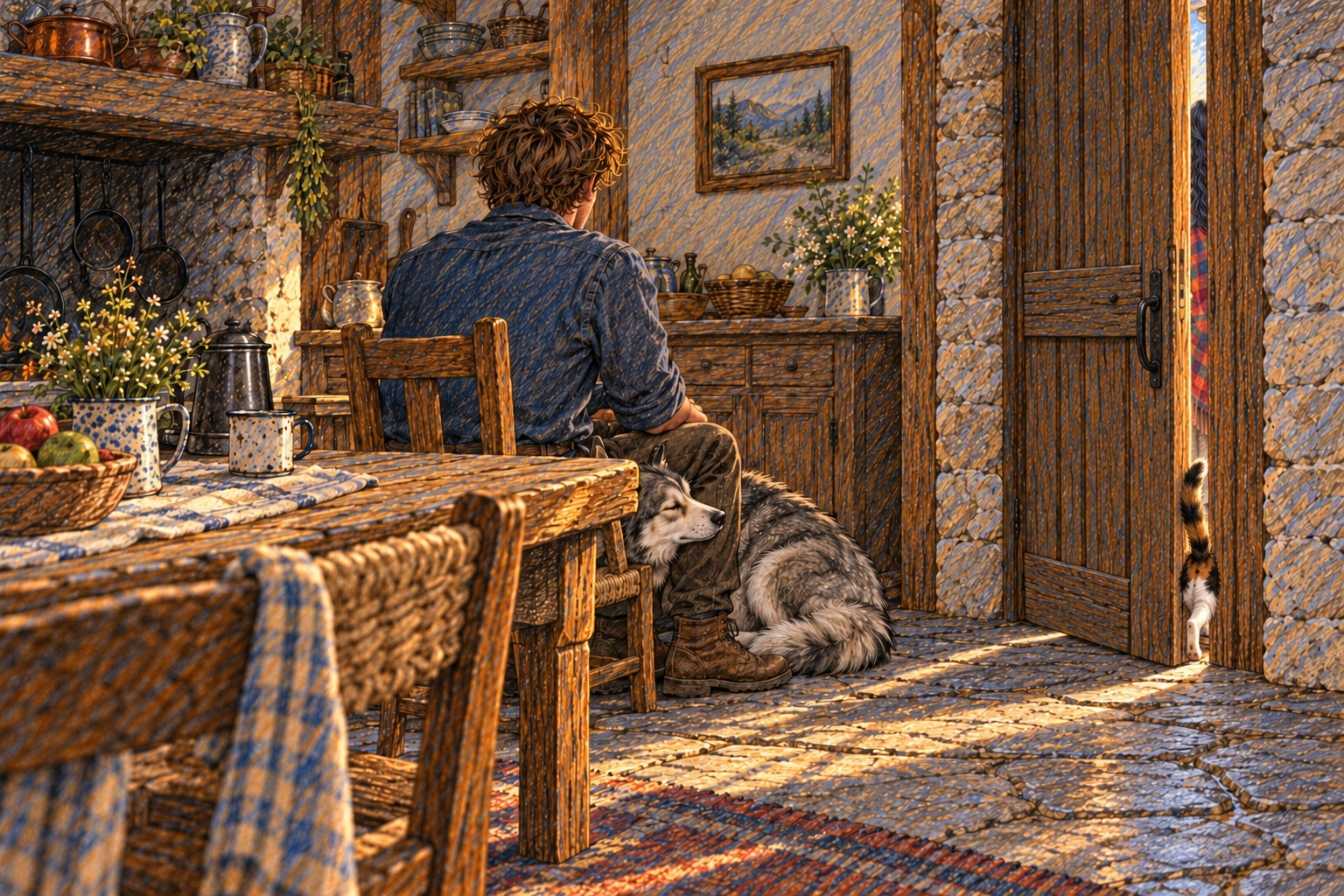
Axel moved away from the door and sat at the far end of the kitchen with his back to the balcony. He kept his hands still on his knees. He wanted to do the washing-up, pick up the broom or go out for water, but he made himself stay there without finding a job to do.
Fay went out onto the balcony through the gap and sat on Eva’s feet. Kika stayed with Axel and rested her head on his knee.
Twenty minutes.
When Eva came in her eyes were red and her face was calm. She put the phone on the table, on top of the policy.
“She’s coming.”
“When?”
“Saturday week.” She sat down. “She says Hortensia’s bringing her. Don’t ask me how, but Hortensia’s bringing her.”
“Okay.”
“And if she comes and I make a mess of it, I’m the one making a mess of it.”
“Okay.”
She sat looking at the table.
“Now you can talk,” she said.
Axel had spent six days rehearsing an enormous speech. When he opened his mouth, he found he could spare her almost all of it.
“I was wrong.”
Eva nodded.
“Okay.” She got up and picked up the bucket. “Go on, up you go.”