
Zoquete
The first winter, a lit bread oven and who left the firewood
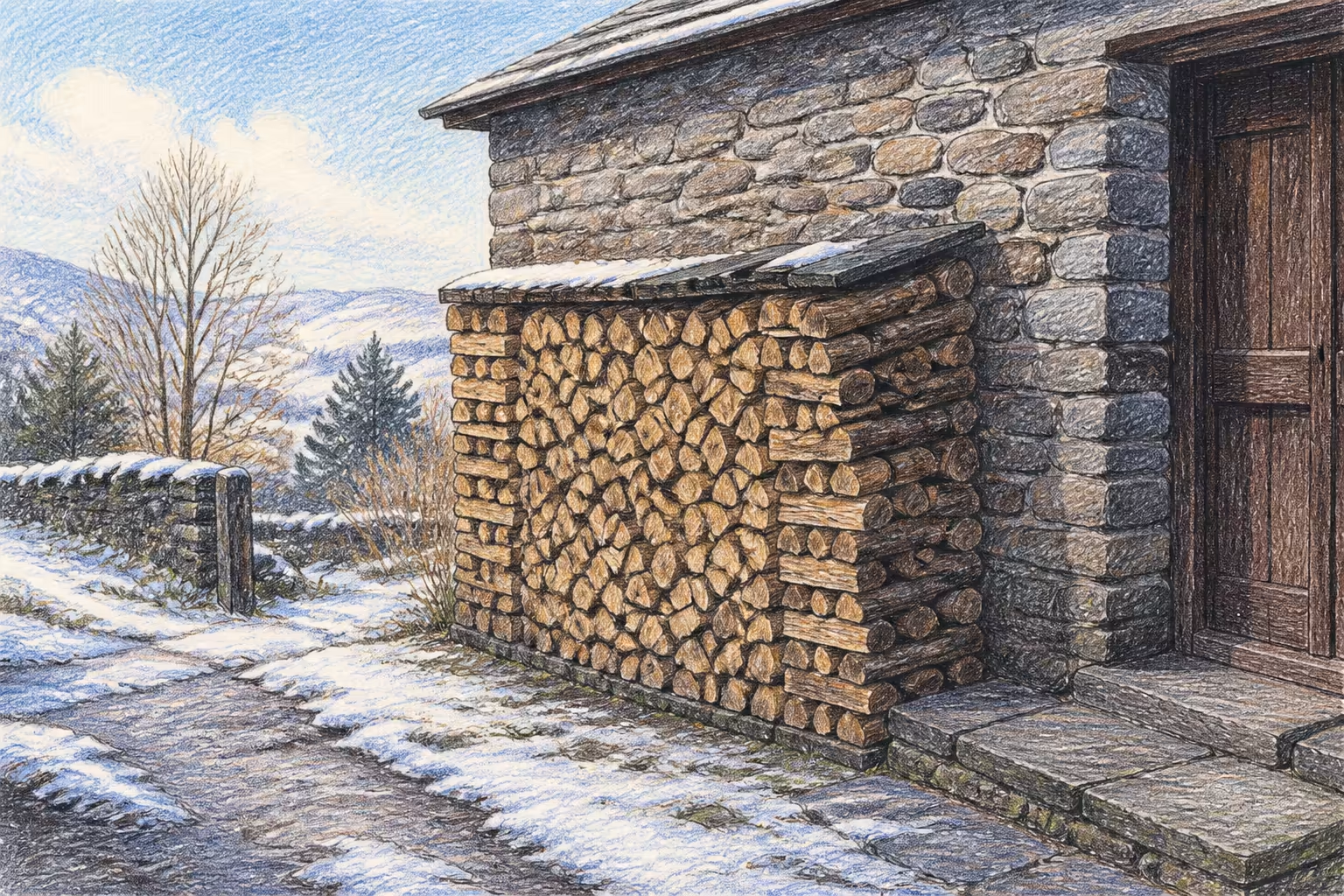
The firewood appeared on a Thursday.
It was at the door when they came down, stacked against the wall, laid properly, with the logs crossed at the ends so it wouldn’t fall. A metre and a half long by a metre high. Oak and chestnut, dry, the good stuff.
Axel went down to the shop to ask.
“Trini, do you know who’s left firewood at our door?”
Trini was doing sums in a notebook with her glasses on.
“No.”
“It’s just that it’s worth a bit of money.”
Trini looked up.
“Well, don’t bring it down to the shop, love, it won’t fit in here.”
And she went back to her sums.
He asked Sabino, who said he didn’t cut firewood any more. Úrsula, who said she bought hers. The lad with the frying pans, who looked at the street and said no idea.
All three with the same face: the face of somebody who isn’t lying but isn’t going to help you either.
That was the first winter. And the first winter was hard, and then it was good, and in that order and not the other one.
Hard was this.
In November it rained nineteen days out of twenty-six and the water didn’t come from above: it came sideways. The new window held. The plastic in the back room didn’t, and there was one night when they got up at one to put buckets out and at three to empty them. And water came in through a spot in the roof that Úrsula had warned would let it in and that Axel had left for the spring, and Úrsula didn’t say “I told you”, which was much worse.
In December the hose froze and they spent six days carrying water up from the fountain in water containers, two per trip, four trips a day. Axel worked out once how many kilos he had carried up that week and decided never to work it out again.
And at some point in that December, coming up with two containers, he stopped in the doorway of the back room.
The school rucksack was still in its corner, upright, the shoelace pulled tight.
It had dust on it. A finger of dust on the top flap, the kind that lifts when a door slams. The dust of a house being worked on, which settles on everything that doesn’t move.
Which meant she hadn’t touched it for months.
Axel didn’t clean it. He shut the door with his foot, very slowly, and carried the containers down to the kitchen.
There was one January afternoon, a Wednesday, at half past five, with the house at nine degrees and the hearth drawing badly because the wind was coming from the north, when Axel sat on the bench with his hands pushed up his sleeves and thought, with all the clarity in the world, that the whole thing had been idiotic.
He thought it in detail. He thought about a radiator. He thought about a small flat with the heating included in the service charge, and the phrase “service charge” struck him as beautiful.
He was like that for twenty minutes.
Then Eva came in with her face red from the cold and a sack of chestnuts somebody had given her, and said “bloody hell, it’s freezing in here”. She took the speaker out of the drawer, where it had sat silent since the robbery, switched it on and put something on. It didn’t come on by itself. She switched it on, and it seemed to Axel that counted just the same. She sat down next to him without taking her coat off, and the two of them sat quiet, looking at the bad fire.
“Are you all right?” she said.
“Yes.”
“All right.”
And she didn’t ask him anything else.
Twenty minutes later the wind changed and the hearth started to draw, and forty minutes later the kitchen smelled of chestnuts, and Axel didn’t remember the radiator again until the following year.
Good was this. That the house filled up.
It filled up in a way neither of them had planned or asked for. Úrsula came to dinner on Thursdays. Sabino came up the street once a week, very slowly, and sat in the kitchen saying almost nothing. The lad with the frying pans started coming with his accordion and leaving without it, and by the third time he didn’t take it away at all. Eva sang in the shop on Saturdays, because Trini thought of it and because people came down from two villages further up. Trini put a tin on the counter and at closing time gave Eva what was inside without counting it, and Eva took it, which was another new thing. One night in February she opened the little notebook on the kitchen table, found the last page, crossed out a line and closed it, and Axel, who had his back to her, didn’t ask which line it was. He already knew.
In February he went down to ask for work at the hotel.
Hotel is a big word for it: it is the big house at the entrance to the village, the one with the metal sign, eleven rooms, and it has been there since before he was born. A family runs it, and it goes the way everything goes up there: slow in winter and rushed off its feet in summer, because the walking routes up top have become fashionable and people turn up at nine at night asking whether there is anything left.
It took him two weeks to go down, and both of them were weeks of shame, because what shamed him was how much he wanted it.
They asked him what he could do. He said four years on reception and five languages, and he heard himself say it and it sounded like nothing much. It didn’t sound like nothing much to the other man: in August he had had two French people and a German in there at the same time and had spent half an hour with his phone held out in front of him.
He started on the Monday.
He did the same thing he had done for four years behind a counter: the board of keys, the book, telling somebody that number five looks onto the yard and nothing is going to disturb them. What had changed wasn’t the job. It was that at ten he locked up, walked up a cobbled street and knew the name of everyone he passed.
And there were creatures. In a place people come through every day, there are. One of them made a business of taking the keys off the board and hanging them on the hook next door, and Axel put them back and said nothing, and the next day the same. The day a family turned up with three kids and a dog he counted six hats along the upstairs corridor and lost the whole afternoon to how happy he was.
And he cooked for whoever turned up, which was what always ended up happening.
One night a bloke of about thirty came down to reception because he couldn’t sleep. He had been walking two days and on the third he was going back, because he worked on Monday. He sat on the sofa with a glass of water and asked him what everybody asked him: how he had ended up there.
And Axel, who had spent twenty-seven years unable to say out loud what he had inside, leaned on the counter and said it.
“The way I see it, it’s a vase.” He pointed with his chin at the one on top of the sideboard, which was empty because nobody ever remembered to put anything in it. “They give you one when you’re born, empty, and there isn’t another. And what you have to do is fill it with things that actually happened to you. The more the better, and the better the better still.” He shrugged. “And I had mine with four years of nothing inside.”
“And if it fills up?”
“God, I should be so lucky.”
He put the key to number five on the counter and the bloke went up.
And Axel stayed there on his own for a while, realising that he had just told a stranger, out loud and without it costing him anything, the only thing he carried inside. And that he had spent three years with somebody without telling her.
Eva started getting calls about her own thing.
It started with a girl from the lower street, nine years old, whose mother wanted to sign her up for something and there was nowhere to sign her up for. Half an hour on Tuesdays, in the kitchen, no sheet music and nothing written down. By the third week there were two. Before the spring there were five, and one came up from two villages further on in her father’s car.
She didn’t teach them to sing well. She said that herself and she meant it: she taught them to sing without looking anybody in the face while they did it.
The first time a mother put a note in her hand she didn’t know what face to make. By the fourth she was charging properly.
And once a month she took them out.
That came about with nobody planning it, out of a rainy afternoon when there was no singing to be done in the kitchen and the five of them ended up under a sheet of plastic tied between two chestnut trees, eating bread and chocolate. After that it was one Saturday a month: a sheet of plastic, five metres of rope, a small fire and coming back at night with the parents waiting at the fountain. She taught them to put up a shelter in four minutes. She taught them that if you leave the box of matches outside the plastic you’re an idiot and nobody tells you twice.
What she didn’t tell them was who she had learnt it from.
And the Thursday thing grew on its own. It started out as Úrsula, and by January it was whoever came up. Nobody proposed it and nobody organised it: it happened three Thursdays running and on the fourth Trini gave Axel twice as many potatoes without asking.
And nobody ever said anything. Nobody said “we’re going to look after you”. Sabino didn’t give him a single piece of advice all winter, not one.
What they did was this:
Somebody left firewood at the door and didn’t say who.
Somebody, on a day when Axel went down with a fever for bread, swapped his loaf for a bag with two sachets of stock in it, didn’t charge him for the sachets and didn’t say a word.
Somebody changed the bulb in the street lamp on their street, which had been out for three years.
And Axel spent the winter trying to work out who did each thing, and at some point in February he stopped trying.
He missed Yayo on a Tuesday.
He took the stool up, put his head into the chimney with the head torch on and looked at the ledge.
It was empty. There was the little piece of checked blanket, folded in four, in one corner. And nothing else.
Axel got down off the stool with a thing in his chest, and he didn’t tell Eva because he didn’t know how you say it.
In the afternoon he went up to the back room. Wamba was on his beam, above the elder tree, which in January looked like a bundle of wire.
“The one in the chimney isn’t there any more.”
And Wamba, without turning round, said:
“He’s downstairs.”
“Downstairs where?”
“In the byre. Next to the door, where the sun comes in in the morning.”
Axel stood there a second.
“And is that good?”
And that time he did turn round.
“Honestly,” said Wamba, with infinite irritation, as though he had been asked the stupidest question in the world. “The chimney ones are the ones for shut-up houses.”
And he went back to looking at the tree.
Axel went down to the byre. He looked for half an hour and saw nothing.
But next to the door, in the spot where the sun comes in in the morning, there was a rush-seated chair he hadn’t put there.
Axel put his hand in his pocket, took out the mother-of-pearl button he had been carrying since August and left it on the seat, in the middle, well centred.
The next morning it was gone.
They lit the bread oven in March.
It wasn’t anybody’s idea. It was that Úrsula, measuring the gutter, said in passing that that vault was in better shape than hers, and Sabino, from his chair, said that he remembered the bread Hortensia’s mother made, and three days later there were four people in the vegetable patch arguing about how you cure an oven that has been cold for forty-one years.
You cure it slowly. Sabino didn’t say that as advice, because he didn’t give advice: he said it as a fact. Four days of small fires so the stone doesn’t crack, and on the fifth you can.
On the fifth Axel made thirteen loaves, because thirteen was the number, and eight came out well and five came out the way they came out.
Half the street came up. Trini came up, and shut the shop for an hour, which she had never done. The woman from the third house came up with a basket. The lad with the frying pans came up without the accordion and with his hands, which was what was needed.
Nobody paid anything. And the following week there was a dozen eggs, a rabbit and a sack of last year’s chestnuts at the door, and nobody ever said whose they were.
Axel rang Hortensia that night to tell her and didn’t get it out whole, because halfway through the first sentence she was already crying and saying what a silly thing, love, if it’s only bread.
“Tuesdays,” she said, when it had passed. “In my house it was Tuesdays.”
And from that March on it was Tuesdays.
He asked at the end of March, in the vegetable patch, planting garlic under the old apple tree, which Úrsula had pruned brutally in January and which was putting out four flowers like somebody asking forgiveness, and he had been thinking about it for weeks. He asked the right one, who had spent three days turning up mid-morning to do absolutely nothing: sit on the edge of the bed with his legs dangling and give his opinion.
“Gorgorito.”
“What.”
“How do you make them come to a house?”
“Make who come?”
“You lot.”
The little brownie thought about it for less than a second.
“Well, don’t make it boring,” he said.
And he carried on watching him work.
Axel stayed on his knees in the bed, with the garlic in his hand.
What came to him was not the house. It was a dirt track, at night, with the rain stopping and a speaker playing inside a rucksack, and a little voice saying I go where things happen.
A whole year to answer that.
“Right,” he said.
And then, because by now it didn’t embarrass him:
“Do you want chocolate?”
“Honestly.”
He saw the last one in April, a year and a month after leaving his flat with a rucksack and a list with the grammes on it.
He was sitting on the kitchen window ledge, on the outside, looking in: very small, very round and with a woollen thing on his head that wasn’t a hat, it was a sleeve.
Axel opened the window.
“Evening. Are you new?”
Nothing.
“What’s your name?”
The creature looked at him for a very long while, with enormous attention, and didn’t open his mouth.
He didn’t open it all the following year, or the one after, or ever.
“Zoquete,” said Axel.
The creature nodded once, very slowly, as though he thought that was fine.
At Christmas Axel had sent three postcards.
One to Bruno and Clara. Another to Otilia, the one from the closed hotel, who didn’t answer. And the third to a mountain village, with the address put down by guesswork because he had no other: “Nardo, the one with the boat”, and underneath the name of the village.
The answer came in April, in a proper letter, with a stamp, which Trini brought up in person because it seemed to her that this was something you bring up in person.
Inside there was half a sheet of notepaper in the handwriting of somebody who presses hard on the pen.
Knocking the wall down in June. Putting her in the water the first Saturday in August, eleven in the morning, and if it rains too. Come, the boat is big. Nardo.
Axel stood there with the paper in his hand.
Eight years sanding, and the man had put down a date.
And he remembered all at once a night under a hull, with Eva four metres away in the dark saying “me too” and turning over before he had time to answer.
That night the house was full. Úrsula was there and Trini and Sabino in his chair, and the lad with the frying pans with the accordion that lived there now, and the woman from the third floor, who had come up with a dish and stayed, and Kika under the table, who was fat by now.
Eleven.
Axel made the stew crouched at the hearth, stirring with a stick, for eleven people.
And over dessert he read the letter out loud.
What happened next was decided by nobody, which is how good things get decided. Úrsula said she’d drive. Trini said she’d shut on the Saturday, and shutting on a Saturday, in that shop, is the nearest thing to an oath there is. Sabino said he wasn’t getting on any boat, but that he was going. The lad with the frying pans asked whether the accordion would fit. And Hortensia, to whom Axel sent a photo of the letter from the table, answered four minutes later with nine words: “Paco has a car and I have Sunday off”.
Eva said nothing.
At some point, between the smoke and the noise, he remembered a night at his own kitchen table, with his phone propped on a pizza box, with a piece of pre-frozen pizza stuck in his throat and the absolute certainty that he was going to die right there.
It seemed to him like centuries ago.
He didn’t tell anybody, because he was serving.
Before singing, Eva climbed onto a bench, and while people were going quiet she pointed at Axel’s feet with her chin.
“They smell,” she said, out of the corner of her mouth, so only he would hear.
“I’m barefoot, Eva. Like you.”
“Right. But mine don’t smell.”
And she started to sing.
They all left at gone one and the two of them cleared up, as always, without dividing it. And when Eva had already gone off to the room, Axel stayed last in the kitchen, turning things off.
He opened the drawer, took out the bar of chocolate he had bought at the shop on Thursday and broke off a piece. A good piece, not a corner.
He went out onto the balcony.
On the window ledge, in the spot where the one who didn’t talk had been sitting, there was already a piece.
A big one. Broken off any old how, the way she breaks things.
Axel stood a moment with his own in his hand. And then he put it next to the other one, and went back in, and said nothing. Not that night and not any other.
Then he stood there, with his hand on the window, and the usual question came to him.
The one from when he was eight. The one from the wood. The one from the café. The one from ten past four one morning. The one from a half hour that wasn’t anywhere.
This time he realised something: that he hadn’t asked it for months.
Something else: that the answer was never going to come, not from a test, not from a whole village talking about them the way you talk about the weather. That he could stand there all night with his face pressed to the glass, waiting to see whether something happened to a piece of chocolate.
He shut the window. He turned off the light. And he went to bed without looking.
That was the only thing he did differently, and it cost him, and he did it.
And in bed, in the dark, the day went past him, which was the thing from every night.
He had brought wood up twice. He had made a dough and it had come out badly. He had spent forty minutes arguing with Úrsula about a gutter. He had put a piece of chocolate on a windowsill next to another piece of chocolate.
He was asleep before he finished looking at it.
Not always. That has to be said.
It had come back in January, one afternoon at nine degrees, with the word “community” sounding lovely to him. It came back in March, on a Sunday when he did absolutely nothing, and he lay awake until three with the hole in the usual place. And it was going to come back in May, and in October, and a good many times more.
It didn’t go away. He understood that at some point that winter and told nobody: that it wasn’t a thing you fix, but a thing that comes, the way the cold comes, and that he had walked a thousand kilometres to find that out. What had changed was what came afterwards. Before, he swallowed it whole and by the morning he remembered nothing. Now he stayed with it a while, and the next day he had to open at eight.
And there were Sundays when he did nothing at all. He sat on the step with the sun in his face and spent two hours watching Kika chase a fly she was never going to catch. And on some of those nights it came and on others it didn’t, and he never knew what it depended on.
That night it didn’t come.
In the morning it wasn’t there. There were four crumbs on the ledge and a damp line where it had melted a little with the dew.
Fay was sitting right underneath, on the balcony, licking his lips.
Axel stood a moment at the window. And he laughed to himself, with his hand on the latch, because of the two things that could have happened out there that night, both of them seemed fine to him.
As he turned he saw Nardo’s letter pinned with a drawing pin to the frame of the kitchen door.
He hadn’t put it there.
Eva went past behind him with the bucket, on her way to the stairs.
“Are you coming down or what?” she said. “Úrsula’s coming today about the gutter and the ladder has to go up first.”
“It’s just that I don’t know if the new one will take the weight of…”
“Give it a good kick, Axel.”
And she carried on down.
Halfway down the stone stairs, without turning round, with the bucket knocking against her knee:
“Somebody said that to me once.”
“I know.”
“Well then.”
And Axel stood for two seconds in the middle of the kitchen with a look on his face that nobody saw.
Then he picked up the other bucket and went down after her.