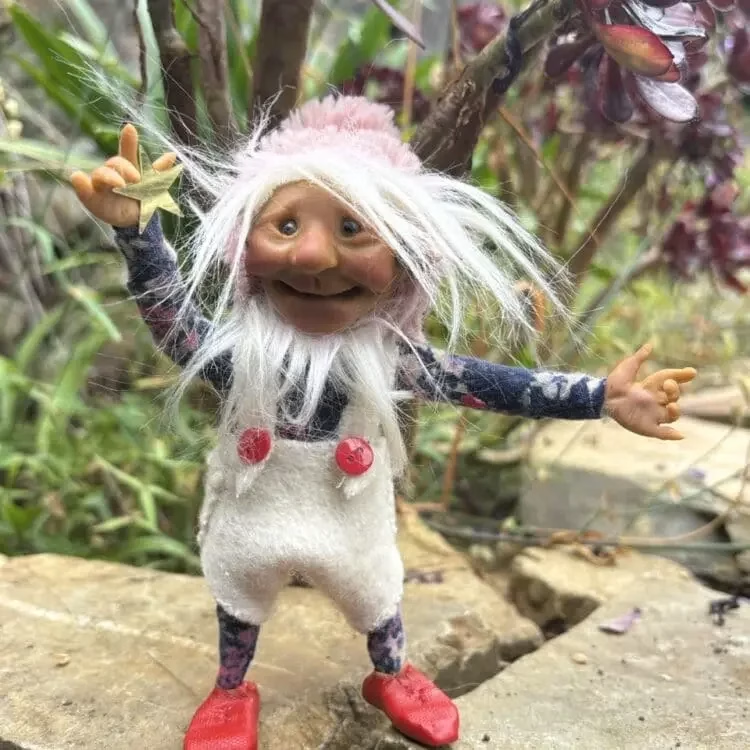
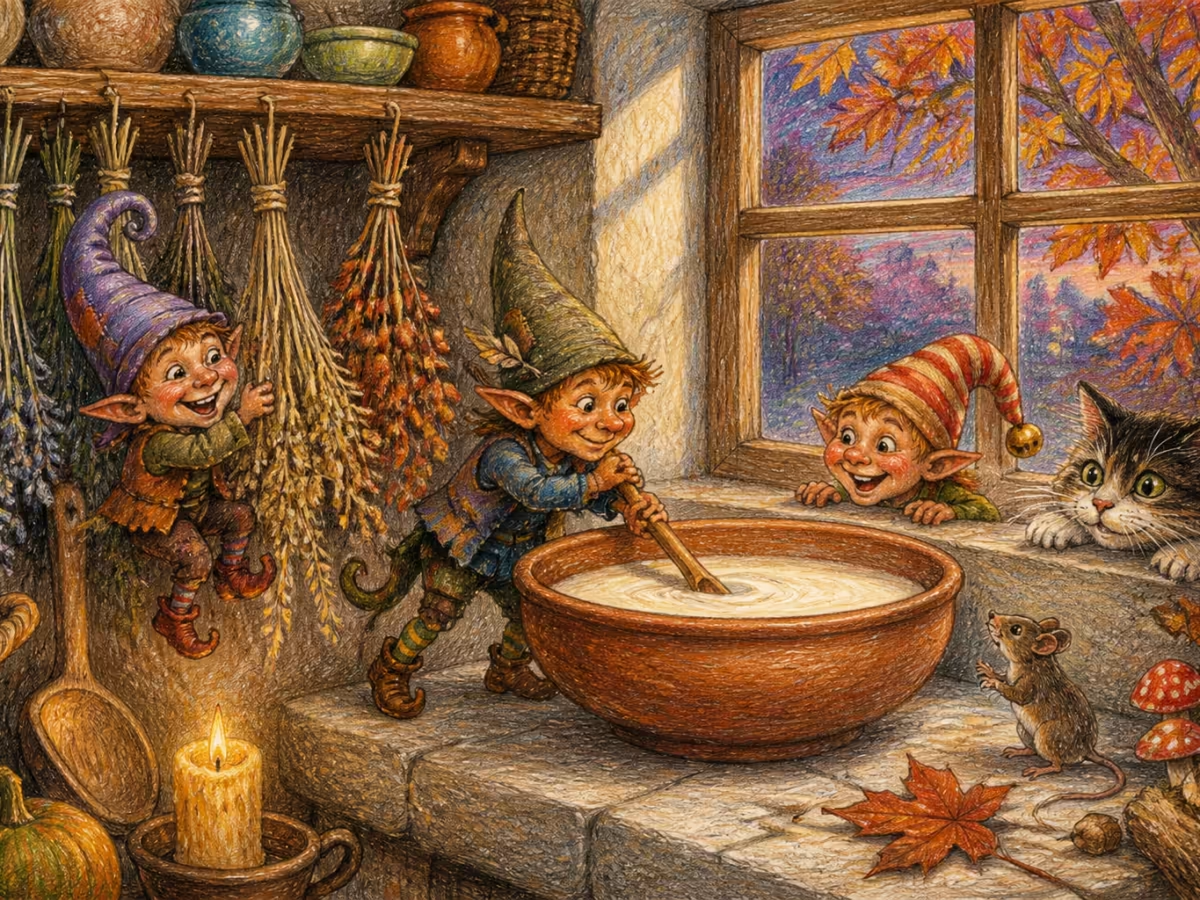
European folklore never settled for nuance. For every spirit that tidied the pantry, there was another that hid the pantry key. For every quiet helper working through the night, a trickster waited in the shadows. The Brownie family across Europe was always two things at once — and no one ever decided which half was the real one.
The great divide
What makes the duality of European household spirits so remarkable is how independently it emerged. British Brownies and Boggarts, German Kobolde, French Lutins, Italian Folletti, Iberian Trasgos — each tradition drew the same line between helpful and harmful without borrowing from the others. The collective imagination needed its household spirits to be unpredictable, because unpredictability was easier to live with than unexplained silence.
The helpful version is not a reward for good behaviour. The trickster is not a punishment. They are simultaneous possibilities, present in the same being at the same time. Which one you get depends on something the folklore is remarkably consistent about: the quality of the relationship.
The benevolent Brownie
The helpful household spirit does not announce itself. Its signals are domestic and quiet: the bread that didn't go stale, the door that latched on its own, the firewood that appeared already split. This kind of spirit understands the home as a shared project and participates from the margins.
Three traits define it across almost every tradition:
- Quiet reciprocity: it works best when acknowledged. A bowl of cream by the hearth, a crust of bread without fuss — the alliance holds for generations on very little.
- Invisible protection: it never frightens guests or disrupts sleep. It moves in the gaps of the day, in the minutes without witnesses.
- Long memory: it remembers every gesture of welcome and every slight. A lapsed ritual may take months to show — but when it does, the shift is unmistakable.
The northern Iberian tradition portrays this figure as almost craftsman-like in its habits — a domestic worker with a self-assigned role it fulfils with quiet pride. The Trasgu of northern Spain is among the most documented examples before it tips into mischief.
The trickster Brownie
The trickster doesn't break things. That would be too blunt, too repairable. Its method is more surgical: it displaces. Rearranges. Substitutes. It puts the left shoe where the right one was, and sits somewhere invisible waiting to see how long it takes you to notice. It doesn't operate from malice but from something closer to cosmic boredom.
Its preferred targets are never the chaotic ones — they've already integrated disorder into their daily operating system. It goes for the meticulous: the person who always leaves the keys in the same spot, who shelves books alphabetically, who turns off the second light before leaving. That person is the perfect canvas.
Five European traditions
Each culture drew this duality in its own colours:
- Brownie and Boggart (British Isles): the Brownie works out of love for the home; the Boggart is the same creature when the home has let it down. Two names, one divided soul.
- Kobold (Germanic countries): reliable and hardworking as long as it receives its daily portion. Left untended, it becomes a disruptive presence — knocking walls, mixing tools, turning chores into a test of patience.
- Lutin (northern France and Brittany): temperamentally erratic from the start. It can be loyal for decades and shift without apparent reason. Breton folklore describes it as following its own incomprehensible mood cycle.
- Folletto (central and northern Italy): has a particular fondness for horses — the good Folletto grooms them and braids their manes overnight; the trickster unsettles the whole stable. Its character depends on whether the stable smells of care or neglect.
- Trasgu (northern Spain): the Iberian household spirit with the longest documented record. Originally framed as chaotic by nature, older accounts show a protective side when the family treated it with respect. Its full story deserves its own read.
What tips the balance
The folklore doesn't tell you which type of spirit is in your home. What it does document consistently is that the spirit's behaviour mirrors the household's, with a lag of weeks or months. This idea appears in too many independent traditions to be coincidence.
- Ritual consistency: it doesn't need to be elaborate. What matters is regularity. A spirit that finds the same bowl in the same place every Thursday feels seen.
- The emotional tone of the home: folklore accounts insist that household spirits are sensitive to the ambient mood. In a home where tension runs constant, the trickster tendency activates as a kind of release valve.
- Attitude towards the unknown: actively dismissing the possibility of something more is, across most traditions, the most direct offence. You don't need to believe; you just need to avoid the opposite.
For more on how this duality plays out across cultures that never met each other, the piece on household spirits around the world maps the same split across continents. And the European Brownie superstitions article documents the rituals each region developed to keep its spirit in helpful mode.
Can a good Brownie become a trickster?
According to most traditions, yes. The Scottish Brownie-to-Boggart transformation is the most documented case — it typically follows neglect, or worse, an attempted banishment. The irony is that domestic exorcism rituals often accelerated the transformation rather than reversing it. Waking something quiet to confirm it's still quiet rarely ends well.
How do you tell if the spirit in your home is the good kind?
The classic signs of the benevolent type are subtle but consistent: things that are where you left them rather than where you thought you left them, discreet nocturnal activity rather than chaos, and a general sense that the house works even if nobody knows why. The trickster's signs are the reverse: a chain of small displacements with no rational explanation that never quite crosses into catastrophe. The difference between the two has less to do with species and more to do with the state of the relationship.