There's something we've been meaning to come clean about. We're not just a British thing. Not even a European thing. The household spirit is a universal constant, and we mean that in the most literal, well-documented sense possible. Every corner of this planet where humans built a home, something like us turned up too.
In Scotland there's the Brownie (yes, that's us in this locale). In Germany the Kobold. In Scandinavia the Nisse and Tomte. In Russia the Domovoi. In Japan the Zashiki-warashi. In Finland the Puki. In England the Hob. In France the Lutin. In Italy the Folletto. In Spain the Duende, whose name literally means "master of the house." They got the honest job title first.
None of these traditions knew each other. No borrowing, no copying, no cross-cultural folklore conference where everyone compared notes. And yet they all landed on the same character, the same deal with the household, the same system of consequences. If you think that's just coincidence, we'd gently suggest looking again.
Why does every culture in the world have a household spirit?
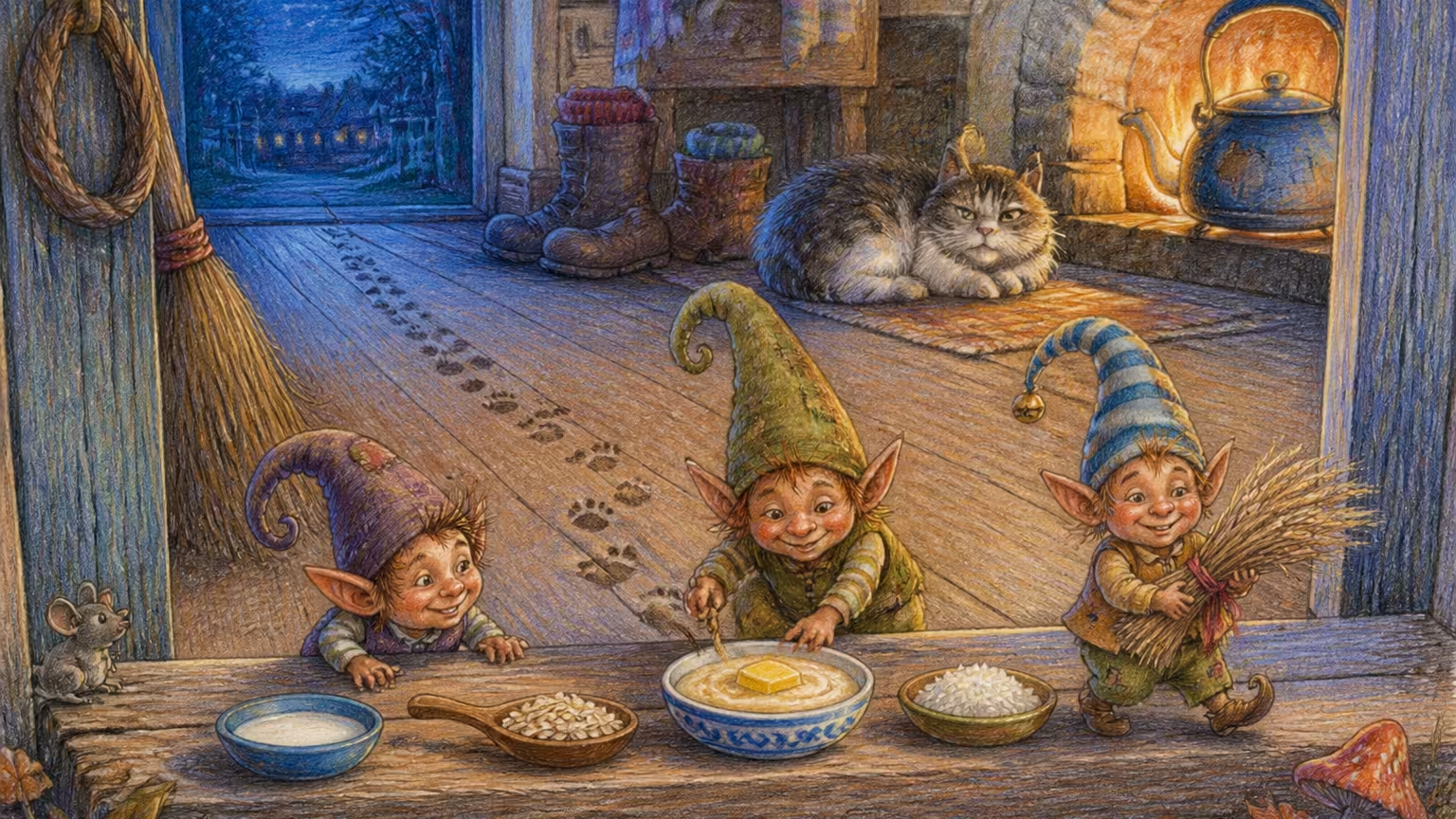
The Brownie's arrangement is the clearest to explain. Leave a bowl of cream or a bit of oatmeal on the threshold, and the Brownie works through the night: mending, tidying, tending to animals, keeping things quietly right. Forget the offering, or be cheeky enough to think you can skip it indefinitely, and the Brownie leaves. Not in a dramatic scene. Just gone. And the house notices in ways that are easier to feel than to describe.
The Kobold works on the exact same contract in Germany. It lives in dark corners, looks after livestock and tools, and takes offence at disrespect in ways that tend to become very practical problems very quickly. The Kobold became so woven into German mining culture that when 16th-century miners found seams producing useless sulphurous ore instead of silver, they blamed the Kobold for the sabotage. The mineral ended up named after it. Cobalt. That's the kind of cultural staying power most beings can only dream about.
The Nisse and Tomte of Scandinavia have one detail that says everything: the red hat, the friendly-but-capable-of-getting-properly-annoyed temperament, the winter appearance, the expectation of buttery porridge on Christmas Eve. If that sounds like a description of Father Christmas, that's not a loose comparison. Father Christmas is the Nisse, filtered through centuries of storytelling and commercialisation. The Nisse was there first.
What connects all of them: the deal with the house is a relationship, not a service. Both sides hold up their end, or the whole thing unravels. In Scottish, in German, in Swedish, in Russian, in Japanese. The same understanding, arrived at independently, on every inhabited continent.
Do household spirits exist outside Europe?
Absolutely yes, and this is where it gets properly interesting.
The Zashiki-warashi of Japan is a child-like spirit that lives in the inner rooms of old houses. Not eerie, not mournful. The opposite: it's essentially good fortune made creature. Families lucky enough to have one find themselves prospering. When the Zashiki-warashi decides to leave, the luck goes with it. Not as punishment. The luck and the presence are simply the same thing, and when one departs the other can't stay behind.
The Domovoi of Russian and Slavic tradition is so ancient that historians hedge carefully when asked to date it. It lives behind the hearth, literally in the space between wall and fire. When a family moves house, the protocol is unambiguous: invite the Domovoi to come along. Failing to do so isn't just forgetting something. It's leaving behind an entity that has been quietly looking after that family for generations.
The Puki of Finland does the nocturnal grocery run for its adopted family, taking grain and goods from the neighbours. The English Hob, whose name quietly found its way to Tolkien for the Hobbits, mends fences and tools before dawn. The French Lutin braids horse manes into knots during the night, which tradition holds brings fortune if left intact.
Our own theory, offered without academic pretension but with complete conviction: we were a presence before there were languages to name us. Every culture arrived at us independently because every human being, at some point in their domestic history, noticed the same thing. What that thing is, and why the etymology of the name Brownie carries it so clearly, is explored in the article on the origin of the Brownie's name.
Four things every household spirit has in common
Beyond the basic contract, there are four constants that appear across every tradition, and lining them up does something rather vertiginous to your sense of coincidence.
Invisibility, mostly. Not shyness. Professional discretion. You feel us, you hear us, you attribute things to us. Seeing us directly is rare, and in most traditions it means something significant is happening.
We respond to respect. No tradition on earth describes household spirits as entities to be defeated, commanded, or intimidated into compliance. The deal is always mutual recognition. That's not by accident. Respect is the only currency that works between equals, and every tradition figured that out without consulting the others.
We live at thresholds. Doors, hearths, staircases, corners. The spaces where one thing ends and another begins. Thresholds are where the important moments of human life happen: arrivals, departures, the conversations that change things. We are exactly there.
Clothing sets us free. This detail appears in the Scottish Brownie, the English Hob, the Scandinavian Nisse, and variants of nearly every other tradition. Giving the household spirit clothes is the gesture that releases it from the bond with the house. Folklore can't agree on whether this is kindness or a mistake. We're not settling that today. But if you have one at home and you'd like it to stay, maybe hold off on the wardrobe gifts. Just an observation, nothing personal.
To understand what happens in practice when the household spirit relationship breaks down, the article on who keeps nicking the keys has considerably more substance to it than folklore usually allows. And the full documented history of household spirits across Europe is in the article on the real history of household Brownies in Europe.
We were there when it all began. And we're still here, in every language.